

"I Live With a Genius"
Lillian Bounds Disney's 1953 Valentine's Day tribute to her husband, Walt

This post is featured on The Newsstand, which is a series that highlights articles that have been published in magazines, newspapers, or other forms of printed media. Be sure to check out the archives for previous posts.
Happy Wednesday, readers! Today’s post is a lil’ different and a bit on the longer side but one that I thought would be really special with Valentine’s Day just a couple days away.
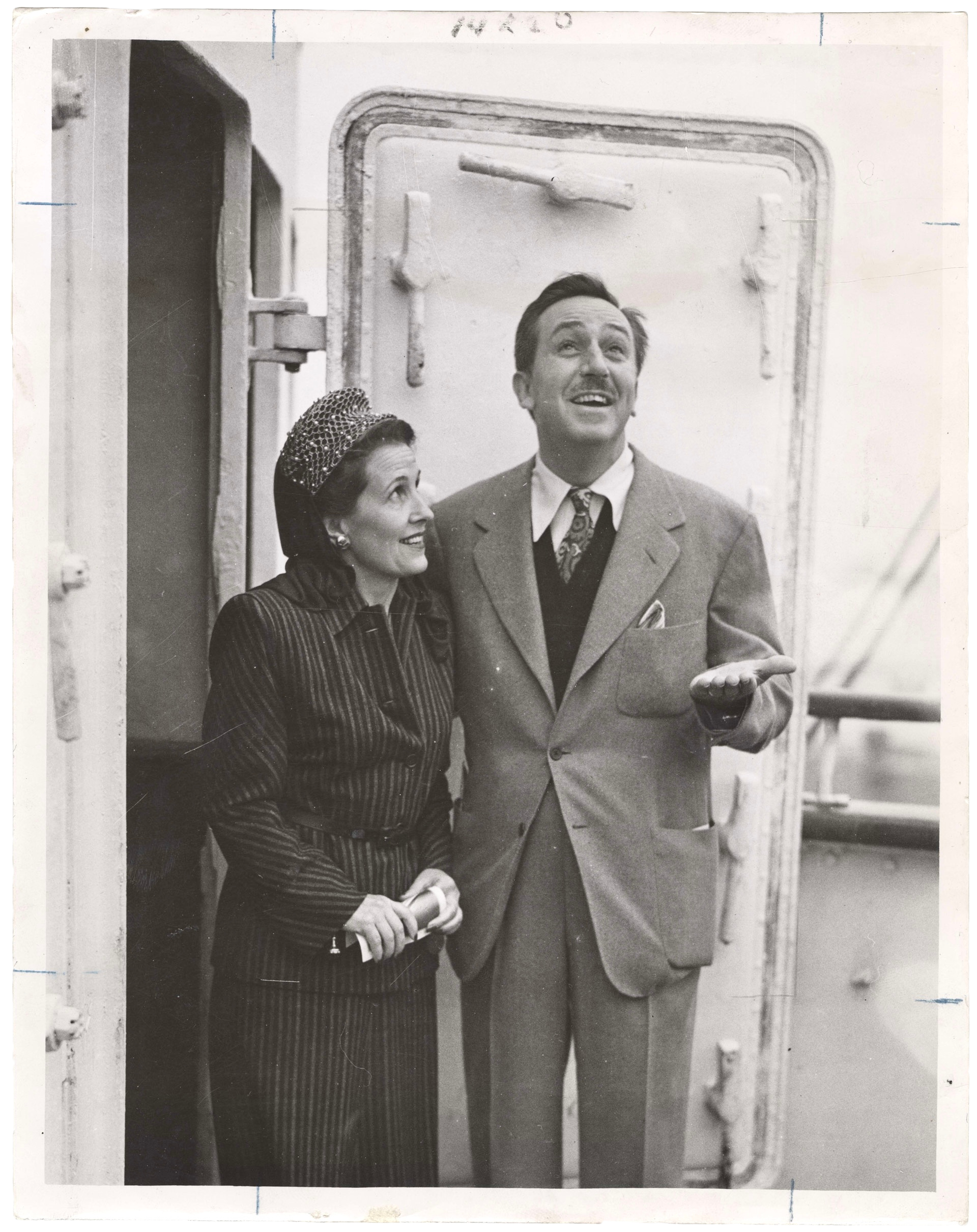
So much of what we know about Walt Disney — the son, brother, husband, father, grandpa, friend, and colleague — has been shared with us through the thoughts and memories of his family and personal relations.
While reading Walt Disney Treasures: Personal Art and Artifacts from the Walt Disney Family Museum, I came across a story that was originally told by Walt’s beloved wife, Lillian “Lilly” Bounds Disney, in the February 1953 edition of McCall’s magazine.1 Of course, I immediately took to the internet to see if I could find any information about the article or a copy of the magazine that I could purchase. Luckily, eBay came through, and now I get to share Lilly’s words with you.
Note: Issues of McCall’s magazine are oversized, which means the pages couldn’t be scanned with my professional scanner. I made do with what I had to include them in this post but for the sake of easy reading, all text was copied and included in quotes below.
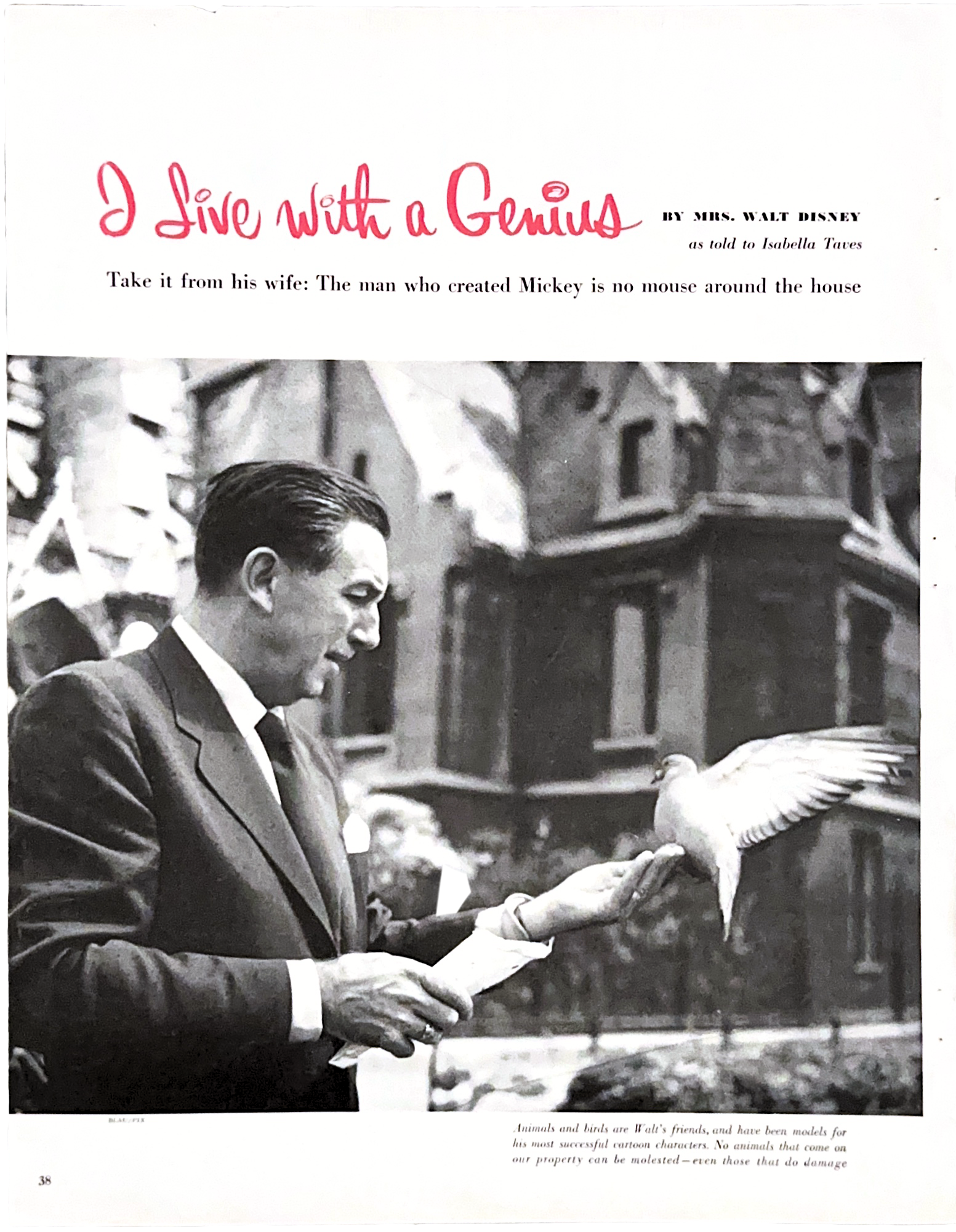
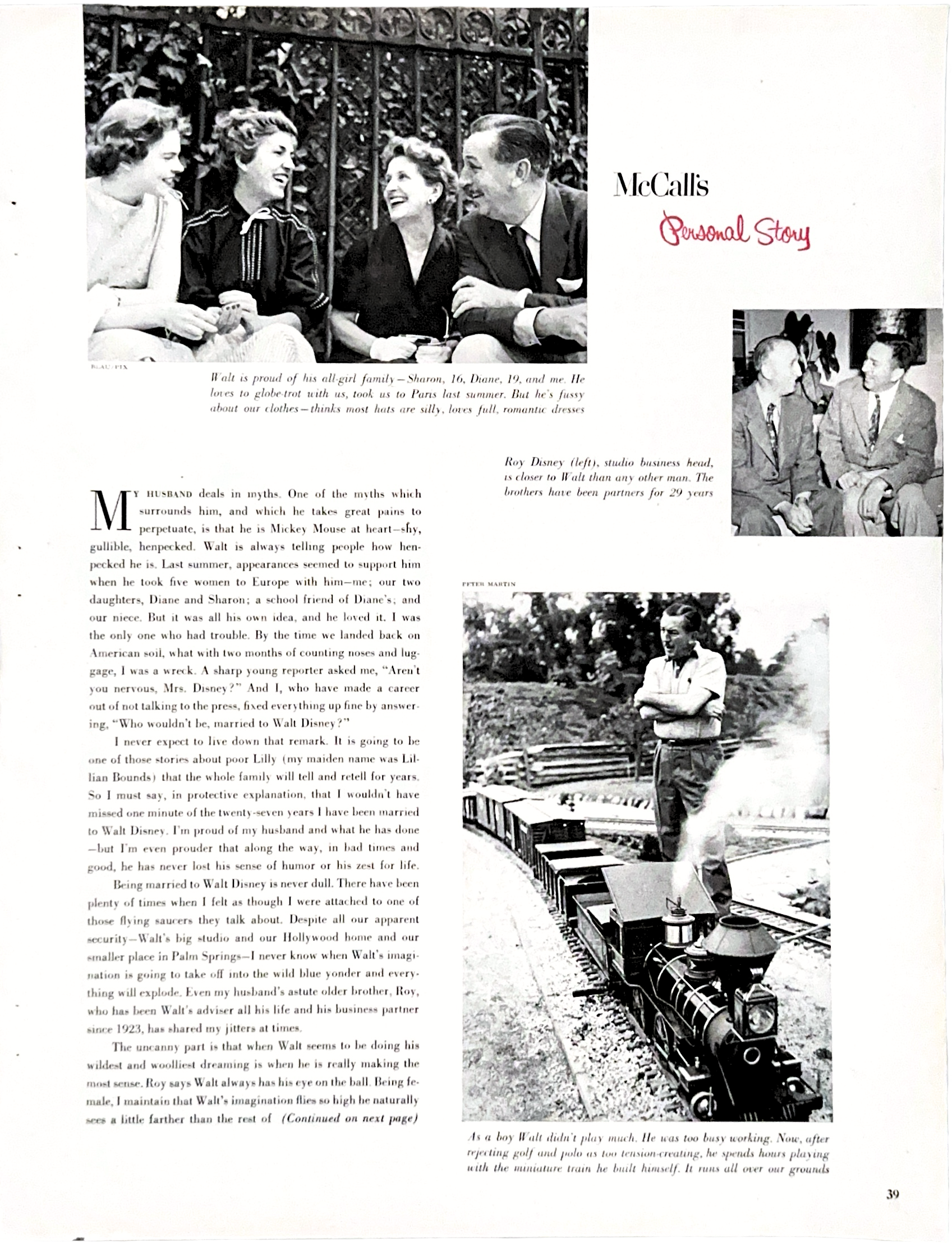
“My husband deals in myths. One of the myths which surrounds him, in which he takes great pains to perpetuate, is that he is Mickey Mouse at heart – shy, gullible, henpecked.2 Walt is always telling people how henpecked he is. Last summer, appearances seemed to support him when he took five women to Europe with him – me; our two daughters, Diane and Sharon; a school friend of Diane’s; and our niece. But it was all his own idea, and he loved it. I was the only one who had trouble. By the time we landed back on American soil, what with two months of counting noses and luggage, I was a wreck. A sharp young reporter asked me, ‘Aren’t you nervous, Mrs. Disney?’ And I, who have made a career out of not talking to the press, fixed everything up fine by answering, ‘Who wouldn’t be, married to Walt Disney?’
I never expect to live down that remark. It is going to be one of those stories about poor Lilly (my maiden name was Lillian Bounds) that the whole family will tell and retell for years. So I must say, in protective explanation, that I wouldn’t have missed one minute of the twenty-seven years I have been married to Walt Disney. I’m proud of my husband and what he has done – but I’m even prouder that along the way, in bad times and good, he has never lost his sense of humor or his zest for life.
Being married to Walt Disney is never dull. There have been plenty of times when I felt as though I were attached to one of those flying saucers they talk about. Despite all our apparent security – Walt’s big studio and our Hollywood home and our smaller place in Palm Springs – I never know when Walt’s imagination is going to take off into the wild blue yonder and everything will explode. Even my husband’s astute older brother, Roy, who has been Walt’s adviser all his life and his business partner since 1923, has shared my jitters at times.
The uncanny part is that when Walt seems to be doing his wildest and woolliest dreaming is when he is really making the most sense. Roy says Walt always has his eye on the ball. Being female, I maintain that Walt’s imagination flies so high he naturally sees a little farther than the rest of us.”
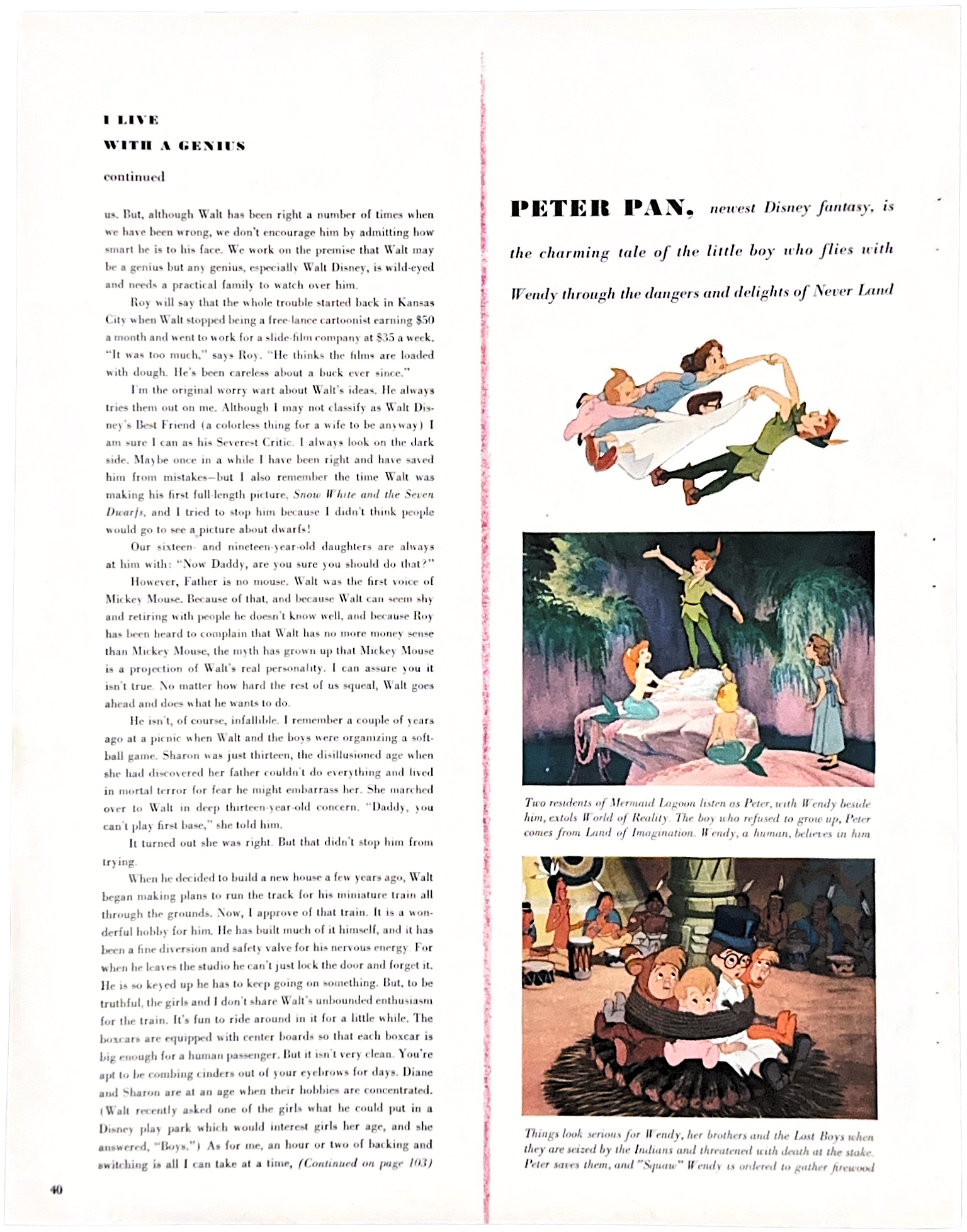
“But, although Walt has been right a number of times when we have been wrong, we don’t encourage him by admitting how smart he is to his face. We work on the premise that Walt may be a genius but any genius, especially Walt Disney, is wild-eyed and needs a practical family to watch over him.
Roy will say that the whole trouble started back in Kansas City when Walt stopped being a free-lance cartoonist earning $50 a month and went to work for a slide-film company at $35 a week. ‘It was too much,’ says Roy. ‘He thinks the films are loaded with dough. He’s been careless about a buck ever since.’
I’m the original worry wart about Walt’s ideas. He always tries them out on me. Although I may not classify as Walt Disney‘s Best Friend (a colorless thing for a wife to be anyway) I am sure I can as his Severest Critic. I always look on the dark side. Maybe once in a while I have been right and have saved him from mistakes – but I also remember the time Walt was making his first full-length picture, Snow White and the Seven Dwarfs, and I tried to stop him because I didn’t think people would go see a picture about dwarfs!
Our sixteen- and nineteen-year-old daughters are always at him with: ‘Now Daddy, are you sure you should do that?’
However, Father is no mouse. Walt was the first voice of Mickey Mouse. Because of that, and because Walt can seem shy and retiring with people he doesn’t know well, and because Roy has been heard to complain that Walt has no more money sense than Mickey Mouse, the myth has grown up that Mickey Mouse is a projection of Walt’s real personality. I can assure you it isn’t true. No matter how hard the rest of us squeal, Walt goes ahead and does what he wants to do.
He isn’t, of course, infallible. I remember a couple years ago at a picnic when Walt and the boys were organizing a softball game. Sharon was just thirteen, the disillusioned age when she had discovered her father couldn’t do everything and lived in mortal terror for fear he might embarrass her. She marched over to Walt in deep thirteen-year-old concern. ‘Daddy, you can’t play first base,’ she told him.
It turned out she was right. But that didn’t stop him from trying.
When he decided to build a new house a few years ago, Walt began making plans to run the track for his miniature train all through the grounds. Now, I approve of that train. It is a wonderful hobby for him. He has built much of it himself, and it has been a fine diversion and safety valve for his nervous energy. For when he leaves the studio, he can’t just lock the door and forget it. He is so keyed up he has to keep going on something. But, to be truthful, the girls and I don’t share Walt’s unbounded enthusiasm for the train. It’s fun to ride around in it for a little while. The boxcars are equipped with center boards so that each boxcar is big enough for a human passenger. But it isn’t very clean. You're apt to be combing cinders out of your eyebrows for days. Diane and Sharon are at an age when their hobbies are concentrated. (Walt recently asked one of the girls what he could put in a Disney play park which would interest girls her age, and she answered, ‘Boys.’)”
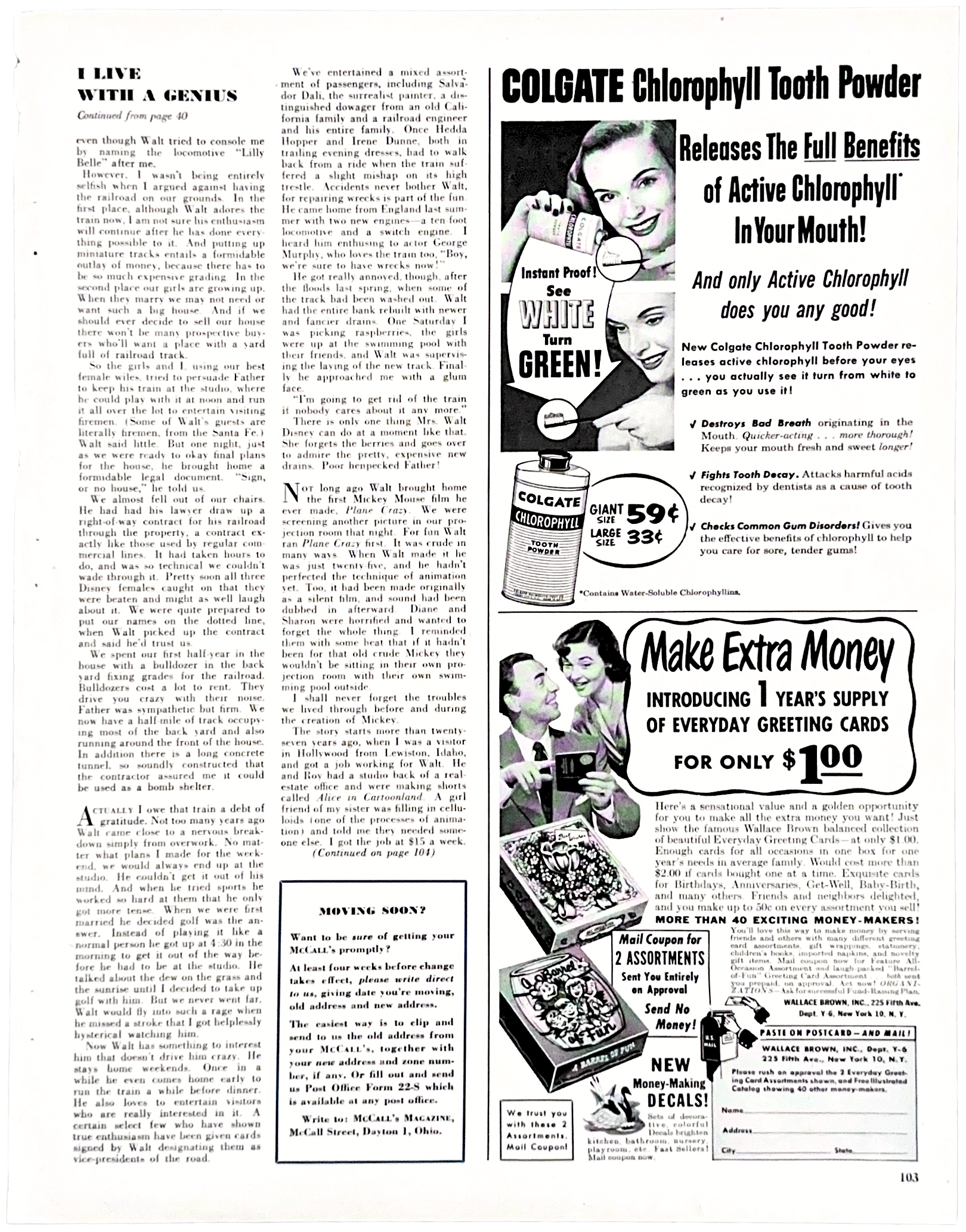
“As for me, an hour or two of backing and switching is all I can take at a time, even though Walt tried to console me by naming the locomotive ‘Lilly Bell’ after me.
However, I wasn’t being entirely selfish when I argued against having the railroad on our grounds. In the first place, although Walt adores the train now, I am not sure his enthusiasm will continue after he has done everything possible to it. And putting up miniature tracks entails a formidable outlay of money, because there has to be so much expensive grading. In the second place our girls are growing up. When they marry we may not need or want such a big house. And if we should ever decide to sell our house there won’t be many prospective buyers who’ll want a place with a yard full of railroad track.
So the girls and I, using our best female wiles, tried to persuade Father to keep his train at the studio, where he could play with it at noon and run it all over the lot to entertain visiting firemen. (Some of Walt’s guests are literally firemen, from the Santa Fe.) Walt said little. But one night, just as we were ready to okay final plans for the house, he brought home a formidable legal document. ‘Sign, or no house,’ he told us.
We almost fell out of our chairs. He had his lawyer draw up a right-of-way contract for his railroad through the property, a contract exactly like those used by regular commercial lines. It had taken hours to do, and was so technical we couldn’t wade through it. Pretty soon all three Disney females caught on that they were beaten and might as well laugh about it. We were quite prepared to put our names on the dotted line, when Walt picked up the contract and said he’d trust us.
We spent our first half-year in the house with a bulldozer in the back yard fixing grades for the railroad. Bulldozers cost a lot to rent. They drive you crazy with their noise. Father was sympathetic but firm. We now have a half-mile of track occupying most of the back yard and also running around the front of the house. In addition there is a long concrete tunnel, so soundly constructed that the contractor assured me it could be used as a bomb shelter.
Actually, I owe that train a debt of gratitude. Not too many years ago Walt came close to a nervous breakdown simply from overwork. No matter what plans I made for the weekend, we would always end up at the studio. He couldn’t get it out of his mind. And when he tried sports he worked so hard at them that he only got more tense. When we were first married he decided golf was the answer. Instead of playing it like a normal person he got up at 4:30 in the morning to get it out of the way before he had to be at the studio.3 He talked about the dew on the grass and the sunrise until I decided to take up golf with him. But we never went far. Walt would fly into such a rage when he missed a stroke that I got helplessly hysterical watching him.
Now Walt has something to interest him that doesn’t drive him crazy. He stays home weekends. Once in a while he even comes home early to run the train a while before dinner. He also loves to entertain visitors who are really interested in it. A certain select few who have shown true enthusiasm have been given cards signed by Walt designating them as vice-presidents of the road.
We’ve entertained a mixed assortment of passengers, including Salvador Dali, the surrealist painter, a distinguished dowager from an old California family and a railroad engineer and his entire family. Once Hedda Hopper and Irene Dunne, both in trailing evening dresses, had to walk back from a ride when the train suffered a slight mishap on its high trestle. Accidents never bother Walt, for repairing wrecks is part of the fun. He came home from England last summer with two new engines – a ten-foot locomotive and a switch engine. I heard him enthusing to actor George Murphy, who loves the train too, ‘Boy, we’re sure to have wrecks now!’
He got really annoyed, though, after the floods last spring, when some of the track had been washed out. Walt had the entire bank rebuilt with newer and fancier drains. One Saturday I was picking raspberries, the girls were up at the swimming pool with their friends, and Walt was supervising the laying of the new track. Finally he approached me with a glum face.
‘I’m going to get rid of the train if nobody cares about it any more.’
There is only one thing Mrs. Walt Disney can do at a moment like that. She forgets the berries and goes over to admire the pretty, expensive new drains. Poor henpecked Father!
Not long ago, Walt brought home the first Mickey Mouse film he ever made, Plane Crazy. We were screening another picture in our projection room that night. For fun Walt ran Plane Crazy first. It was crude in many ways. When Walt made it he was just twenty-five, and he hadn’t perfected the technique of animation yet. Too, it had been made originally as a silent film, and sound had been dubbed in afterward. Diane and Sharon were horrified and wanted to forget the whole thing. I reminded them with some heat that if it hadn’t been for that old crude Mickey they wouldn’t be sitting in their own projection room with their own swimming pool outside.
I shall never forget the troubles we lived through before and during the creation of Mickey.
The story starts more than twenty-seven years ago, when I was a visitor in Hollywood from Lewiston, Idaho, and got a job working for Walt. He and Roy had a studio back of a real estate office and we’re making shorts called Alice in Cartoonland. A girl friend of my sister was filling in celluloids (one of the processes of animation) and told me they needed someone else. I got the job at $15 a week.”
“At that time, Walt and Roy weren’t allowing themselves much more, for nearly everything they made went into the pictures or to pay back money Walt borrowed to start the business. They lived together in a tiny walk-up apartment, with Roy doing the cooking. I’ve always teased Walt that the reason he asked me to marry him so soon after Roy married Edna Francis, a Kansas City girl, was that he needed somebody to fix his meals. But I have one comforting thought. Food isn’t that important to Walt.
Edna tells me that back in the Kansas City days, when Roy was in a veterans hospital after a Navy stretch, she would occasionally invite Walt to dinner so he could have a square meal. But Walt would get involved in working out some idea and forget to turn up until ten or eleven at night. Once, soon after we were married, Walt did the same thing to me. When it came dinnertime, he wandered out of the studio to the corner beanery for a bowl of soup and then right back to the studio to continue with his idea. It wasn’t until far into the night that he woke up to the fact he had a bride at home who had cooked dinner and was waiting to throw it in his face when he turned up.
However, I forgave him. You can’t stay mad at Walt for very long. He is too good at beguiling. I think the apology that time was a hatbox tied with a red ribbon. But don’t think there’s anything as prosaic as a hat in it! It held a chow puppy, with another red ribbon around its neck.4
I quit work when we married. The studio was doing well – so well, in fact, that Walt had hired a couple of cartoonists to help him. They were making animated-cartoon shorts featuring a rabbit named Oswald, for which a New York distributor was paying them $2,250 a film – not as much as it sounds when you take the costs out, but still quite a sum of money to get us in those days.
Right here I want to say another thing about Mickey Mouse. Stories have been printed about how Walt got interested in mice back on the farm in Marceline, Missouri, when he was a kid. Newspaper articles have told how Walt used to have a pet mouse named Mickey, which lived in his wastebasket during the free-lance cartoon days in Kansas City. Walt loves all animals – he won’t even let the gardener and me put out traps for the little ones that are garden pests – but when he created Mickey Mouse there was no symbolism or background for the idea. He simply thought the mouse would make a cute character to animate.
I’m getting ahead of my story, however. Roy and Walt were still working with Oswald the Rabbit when the New York distributor notified them that from now on he was cutting the price per picture almost in half. Walt went to New York to argue that they couldn’t break even that way. I went along too, for a second honeymoon. It didn’t turn out quite that way.
Walt discovered that the distributor owned all the rights to Oswald and intended to go on making Oswald shorts without Walt if he refused to knuckle down to cut the price. Walt got mad and told the distributor what he thought of him. He came back to the hotel and announced that he was out of a job and glad, because he would never again work for anybody else. He never has, either.
I know now how right his decision was, for to function Walt has to be free. I didn’t have the long-range viewpoint that day. I was scared to death. Walt didn’t even tell Roy what had happened, but wired him that he was coming home with a great new idea. On the way back, on the train, he wrote a scenario for a cartoon short to be called Plane Crazy and starring a mouse named Mortimer.
As for me, I was plain crazy. I sat watching the green of the Middle West change to sagebrush and desert. I remembered the early Hollywood days when Walt and Roy were so broke that they would go to a restaurant and order one dinner, splitting the courses between them. I knew I wouldn’t care much for that. I couldn’t believe that my husband meant to produce and distribute pictures himself, like the big companies. He and Roy had only a few thousand dollars between them. Pictures needed a lot of financing, even in 1927. And what if Walt failed? He had insulted his distributor and hadn’t even looked for a new connection.
By the time Walt finished the scenario I was practically in a state of shock. He read it to me, and suddenly all my personal anguish focused on one violent objection to the script. ‘‘Mortimer’ is a horrible name for a mouse!’ I exclaimed.
Walt argued – he can be very persuasive – but I stood firm. Finally, to placate his stubborn wife, Walt came up with a substitute: ‘Mickey Mouse.’ At this late date I have no idea whether it is a better name than ‘Mortimer.’ Nobody will ever know. I only feel a special affinity to Mickey because I helped named him. And, besides, Mickey taught me a lot about what it was going to be like married to Walt Disney. We’ve never been so broke since – at least quite so visibly. But I have been plenty worried on occasion. It has often helped to look back on that period.
Everybody helped Walt. Roy was Jack-of-all-trades, and Edna and I stopped being ladies of leisure and filled in celluloids. We worked night and day.”
“We ate stews and pot roasts, which luckily were cheap in those days. We were down so low that we had a major budget crisis one night when I tripped on the garage stairs and ruined my last pair of silk stockings. Then when we had finished three Mickeys we had an even worse blow. Nobody was interested in them because talkies had just come in and the theaters wanted shorts with sound.
I shall never forget the conversation between Roy and Walt when we made that discovery.
Roy: ‘What will we do?’
Walt: ‘We’ll make them over with sound.’
Roy: ‘How?’
Walt: ‘I don’t know, but we’ll do it.’
Walt can do pretty nearly anything he puts his mind to. That is the way in which he is a great artist, not as a manipulator of crayon, chalk or paint. As a matter of fact, he does very little drawing these days, and never did care much for it. He knew nothing about music, but he began to study it. To this day, he cannot carry a tune, but he has a vast knowledge and understanding of all kinds of music. He seldom wastes time being proud of anything he has finished, but of everything he has made he is most pleased with certain sections of Fantasia, which showed music as it looks to Walt Disney in cartoon and color. I feel, too, that a large part of the charm of his nature films, particularly the recent Water Birds, is due to the musical backgrounds.
The first Mickey Mouse opened in September, 1928, in New York. It had music behind it, but the animals had not yet learned to talk; they made grunting noises. Talking animals were a later brainstorm of Walt’s.
Mickey Mouse won Walt the first of twelve Academy Awards and a great many other awards, including dozens from other countries. One of the curious things about Walt is that he is more often recognized abroad than he is at home. In South America once they made such a fuss over him at a movie theater that I got separated from him. Crowds scare me a little, because I am only five feet tall. All I could think of to do was to follow the man in front of me. I was ready to follow him into the men’s room when the manager of the theater, alerted by Walt, saved me.
Yet Walt’s story is typically American. Last December he was fifty-one years old. Walt was born in Chicago. His father was Elias Disney, an Irish-Canadian contractor, and his mother, Flora Call Disney, was of German-American descent. He was one of five children, with a younger sister and three older brothers. Roy is eight years older and always took care of Walt, just as he still does today. Nobody in the family besides Walt was artistic. Walt drew from the time he was a little boy. When the family moved from the Missouri farm where Walt spent his early days to Kansas City, Walt got free haircuts by drawing cartoons for the barber.
He hated school. It is ironic but also rather wonderful that although he never was graduated from high school he holds honorary degrees from Harvard, Yale, the University of Southern California and Purdue. But he loved to work. He had a paper route. He was a magazine and candy ‘butcher’ on the train from Kansas City to Chicago. He did comedy routines and movie-star imitations on amateur nights at movie theaters, and won a dollar occasionally. When the family moved back to Chicago, he took two jobs, one on the Chicago elevated and another in the post office. He used to carry both uniform caps in his pockets.
The only art training Walt ever had was a night course in cartooning at the Chicago Art Institute. At sixteen he enlisted in the Red Cross and was sent to France to drive an ambulance. He covered it with original Disney cartoons. They attracted a lot of attention, so when he returned to Kansas City he went into cartooning, first as a free-lance artist, later drawing animated-cartoon ads for movie theaters. At twenty he had his own movie company, producing cartoon shorts. At twenty-one he went into bankruptcy. Then he went from door to door taking baby pictures with short ends of film, to earn money to get to Hollywood. He landed there in August, 1923, a few months before he was twenty-two.
The first time Walt ever saw one of his cartoon shorts in a theater was two years later, just before we were married. My sister and I were visiting a friend that night, so Walt decided to go to the movies. A cartoon short by a competitor was advertised outside, but suddenly, as he sat in the darkened theater, his own picture came on. Walt was so excited he rushed down to the manager's office. The manager, misunderstanding, began to apologize for not showing the advertised film. Walt hurried over to my sister‘s house to break his exciting news, but we weren’t home yet. Then he tried to find Roy, but he was out too. Finally, he went home alone. Every time we pass a theater where one of his films is advertised on the marquee I can’t help but think of that night.
Despite all the honors he has won and the fact he is an international figure, Walt is genuinely self-effacing. He likes to wander around almost anyplace, the Farmer’s Market in Hollywood or the Third Avenue junk shops in New York, without being recognized. He has no use for people who throw their weight around as celebrities, or for those who fall over you just because you are famous.
When our girls were little, he made a point of not having Mickey Mouse toys around the house. The only ones they acquired were gifts from people outside the family. It wasn’t until Diane, the older, was big enough to go to school that she found out who Walt was. One night when he came home from work she flung herself on him and asked:
‘Daddy, are you the Walt Disney?’
It is this same attitude of Walt’s that has kept the Disney’s private life private and our girls nice, normal youngsters. I’ll never forget the Christmas Snow White came out. Despite my dire predictions, it was so successful we felt flush about buying presents for the kids. And the studio carpenters had spent days building a replica of the dwarfs’ house for them. For about five minutes the girls were thrilled to death with everything. Then they started playing train with the boxes the things had come in.
Neither Diane nor Sharon has any desire for a movie career, although Diane has inherited her father’s felicity with ideas and loves to write. Both girls want to get married and have children of their own, which I’m vain enough to take as a compliment to Father and Mother.
And here I want to pay a tribute to Walt. Although he is one of the busiest men in Hollywood, he has never neglected his family for business. When the girls were young he would take as much time over a childish problem as he would over a studio crisis.”
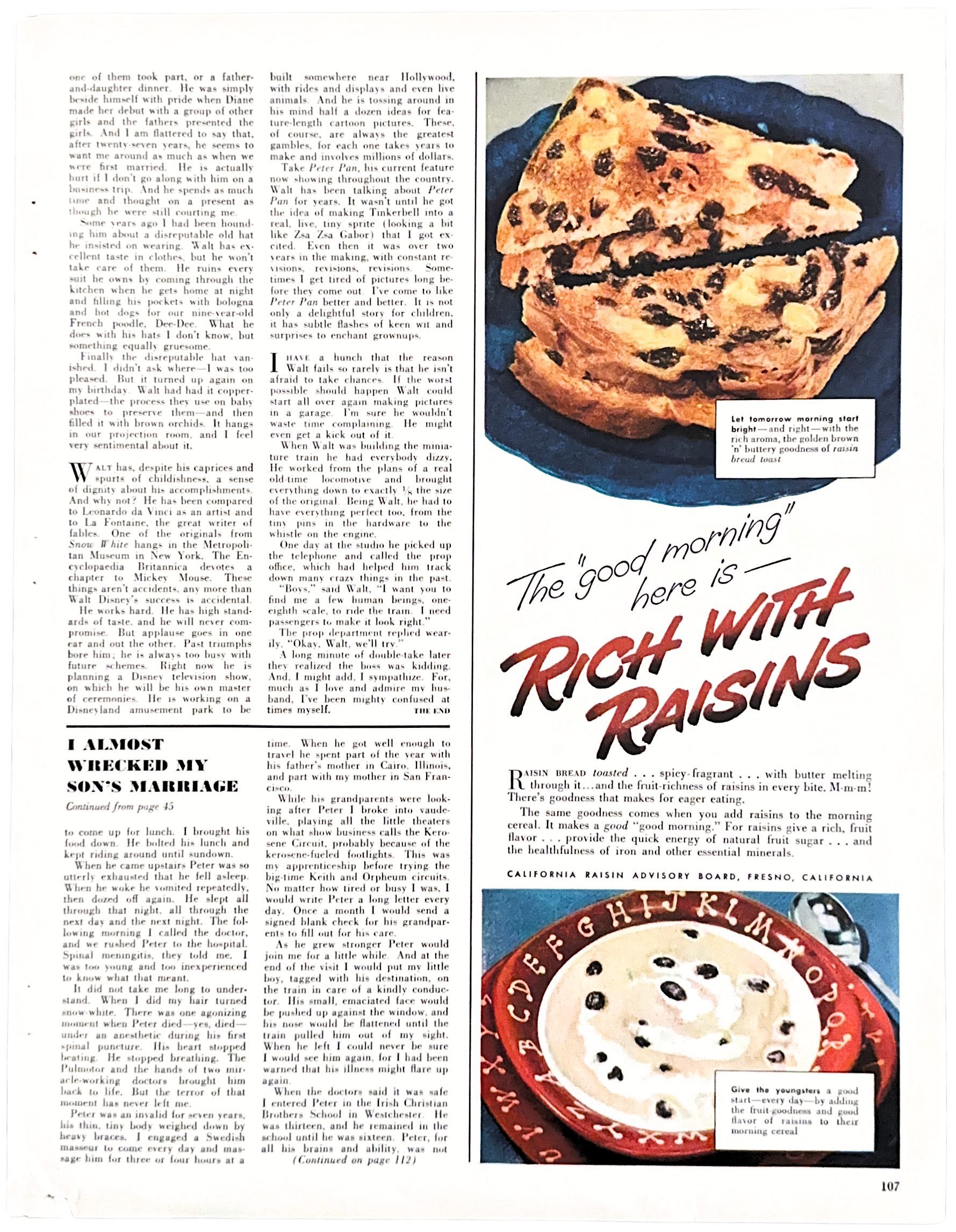
“I don’t think he has ever missed a swimming meet in which one of them took part, or a father-and-daughter dinner. He was simply beside himself with pride when Diane made her debut with a group of other girls and the fathers presented the girls. And I am flattered to say that, after twenty-seven years, he seems to want me around as much as when we were first married. He is actually hurt if I don’t go along with him on a business trip. And he spends as much time and thought on a present as though he were still courting me.
Some years ago I had been hounding him about a disreputable old hat he insisted on wearing. Walt has excellent taste in clothes, but he won’t take care of them. He ruins every suit he owns by coming through the kitchen when he gets home at night and filling his pockets with bologna and hot dogs for our nine-year-old French poodle, Dee-Dee. What he does with his hats I don’t know, but something equally gruesome.
Finally, the disreputable hat vanished. I didn’t ask where – I was too pleased. But it turned up again on my birthday. Walt had it copper-plated – the process they use on baby shoes to preserve them – and then filled it with brown orchids. It hangs in our projection room, and I feel very sentimental about it.
Walt has, despite his caprices and spurts of childishness, a sense of dignity about his accomplishments. And why not? He has been compared to Leonardo da Vinci as an artist and to La Fontaine, the great writer of fables. One of the originals from Snow White hangs in the Metropolitan Museum in New York. The Encyclopedia Britannica devotes a chapter to Mickey Mouse. These things aren’t accidents, any more than Walt Disney's success is accidental.
He works hard. He has high standards of taste, and he will never compromise. But applause goes in one ear and out the other. Past triumphs bore him; he is always too busy with future schemes. Right now he is planning a Disney television show, on which he will be his own master of ceremonies. He is working on a Disneyland amusement park to be built somewhere near Hollywood, with rides and displays and even live animals. And he is tossing around in his mind half a dozen ideas for feature-length cartoon pictures. These, of course, are always the greatest gambles, for each one takes years to make and involves millions of dollars.
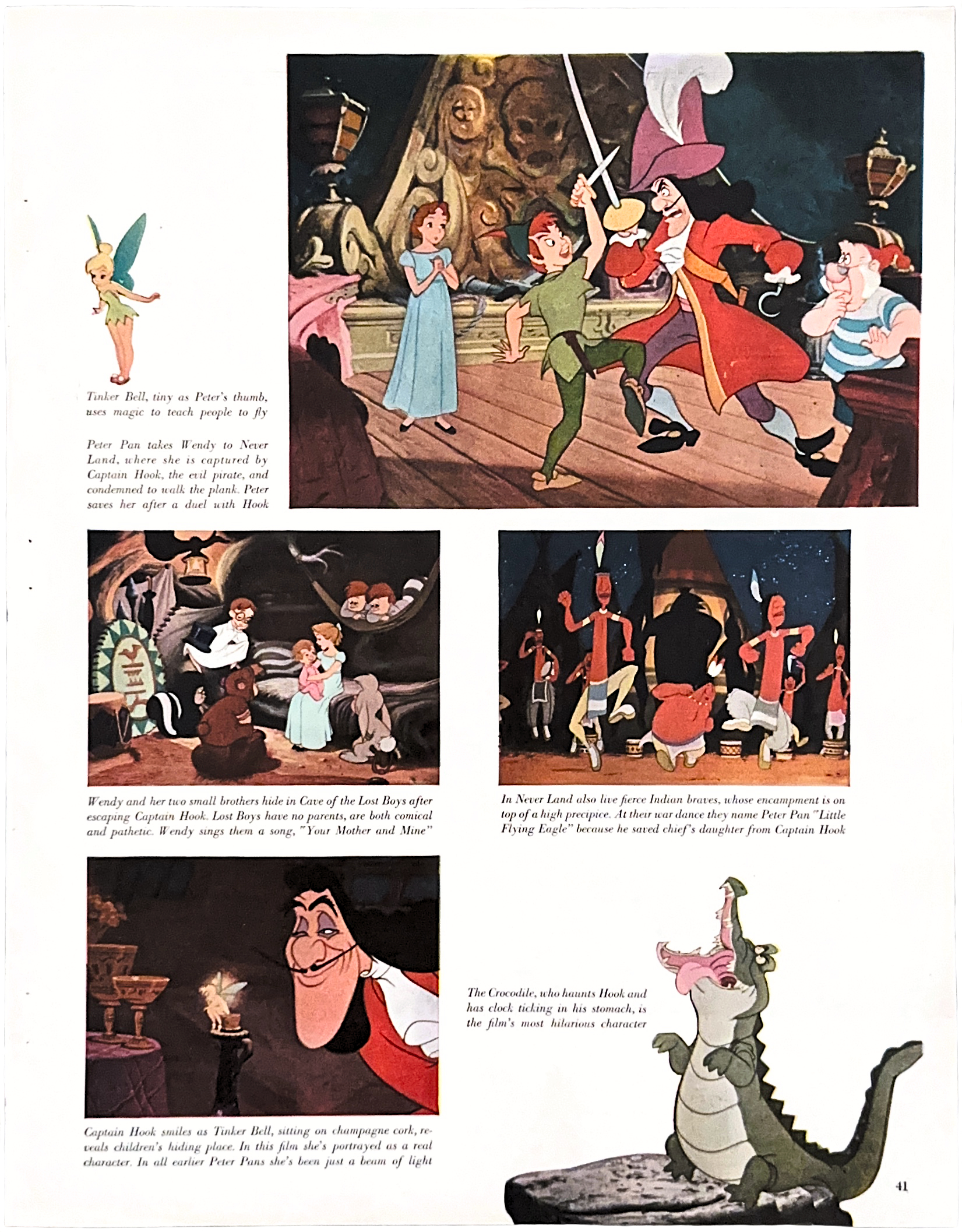
Take Peter Pan, his current feature now showing throughout the country. Walt has been talking about Peter Pan for years. It wasn’t until he got the idea of making Tinkerbell into a real, live, tiny sprite (looking a bit like Zara Zsa Gabor) that I got excited. Even then it was over two years in the making, with constant revisions, revisions, revisions. Sometimes I get tired of pictures long before they come out. I’ve come to like Peter Pan better and better. It is not only a delightful story for children, it has subtle flashes of keen wit and surprises to enchant grownups.
I have a hunch that the reason Walt fails so rarely is that he isn’t afraid to take chances. If the worst possible should happen Walt could start all over again making pictures in a garage. I’m sure he wouldn’t waste time complaining. He might even get a kick out of it.
When Walt was building the miniature train he had everybody dizzy. He worked from the plans of a real old-time locomotive and brought everything down to exactly 1/8 the size of the original. Being Walt, he had to have everything perfect too, from the tiny pins in the hardware to the whistle on the engine.
One day at the studio he picked up the telephone and called the prop office, which had helped him track down many crazy things in the past.
‘Boys,’ said Walt, ‘I want you to find me a few human beings, one-eighth scale, to ride the train. I need passengers to make it look right.’
The prop department replied wearily, ‘Okay, Walt, we’ll try.’
A long minute of double-take later they realized the boss was kidding. And, I might add, I sympathize. For, as much as I love and admire my husband, I’ve been mighty confused at times myself.”

Like Lilly mentioned, any interest by the Disney family in divulging the inquiries and whims of the press were few and far between, especially during Walt’s lifetime. That’s why I found this article so unique for its time.
I think my favorite story is the one where Walt took up golf as a means of diversion from the stressors of the studio. Taking an innocent hobby from zero to one hundred? I certainly don’t know anything about that (wink)!
If you enjoyed today’s post, be sure to smash that lil’ heart icon below! As always, thank you so much for reading. I appreciate you being here.
See ya real soon,

👋🏻 Lookin’ for more magic? Come say “hi” on Instagram!
☕ Help fuel those early mornings and late nights by buying me a coffee
💬 Found something in this post that resonated with you? Highlight and share it as a note to your Substack feed!
💌 Spread the magic by sending this post to a fellow Disney nerd
🗣️ Got a Substack of your own? Recommend Magic, Noted to your readers!
McCall’s magazine was a monthly American women’s publication that ran from 1873 to 2002. It’s issues featured everything from sewing patterns, the latest fashion trends, a column by Eleanor Roosevelt, paper dolls, and short fiction works by notable authors, including F. Scott Fitzgerald, Willa Cather, John Steinbeck, Ray Bradbury, and Anne Tyler.
The term “henpecked” is a bit dated, but it refers to being repeatedly criticized and given orders by one's wife or female partner.
This anecdote always makes me chuckle.