

"Mickey Mouse and What He Means"
Critical observations of early developments in animation and how the public eye can influence its production

This post is featured on The Newsstand, which is a series that highlights articles that have been published in magazines, newspapers, or other forms of printed media. Be sure to check out the archives for previous posts.
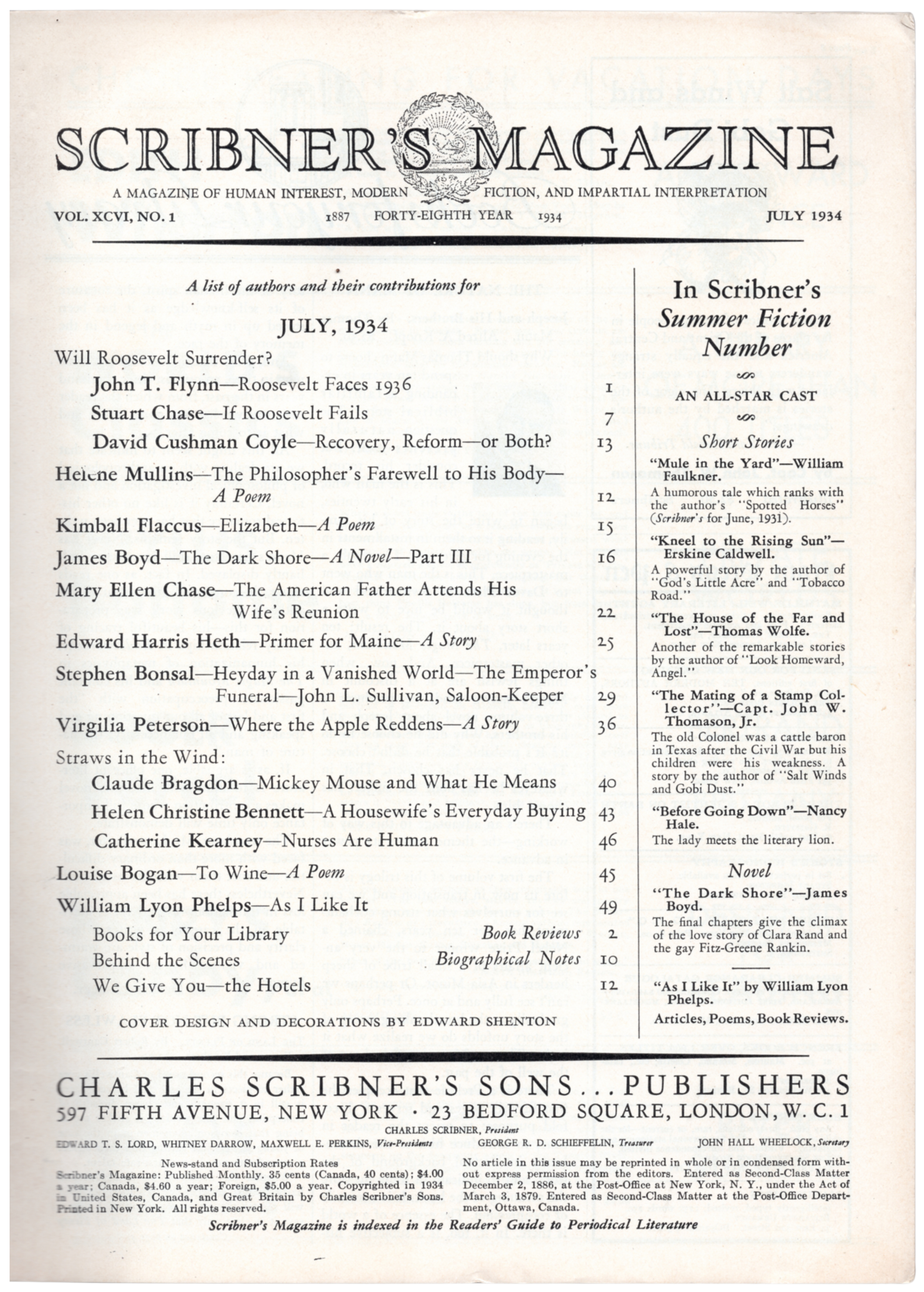
It’s July 1934 and Americans are battling debilitating droughts and Great Depression-era hardships, Franklin D. Roosevelt just became the first sitting U.S. President to visit South America, and geopolitical fractures are continuing to widen across Europe. The Wise Little Hen animated short film features the first appearance of Donald Duck, and Walt Disney Studios’ Snow White and the Seven Dwarves is just over three years away from it’s premiere at Carthay Circle Theatre in Los Angeles, California.
Times are…tough. But even in such periods, solace can often be found amongst mediums of creative expression within one’s self and their community.
As an architect, writer, and stage designer of the early twentieth century, Claude Bragdon was likely no stranger to this idea. By 1900, he was a leading contributor to the arts and crafts movement of Rochester, New York and began aligning his architectural style to that of midwestern progressivism. Much of Bragdon’s work can be characterized by his emphasis on the uniquely geometric qualities of nature, harmonization amongst buildings in an urban setting, and the utilization of architecture as a mirror to reflect the democratic culture in which it exists rather than the individual who designed the structure.
Fun Fact: Bragdon was highly influenced by the work of one of our favorite jack-of-all-trades here at Magic, Noted — Buckminster Fuller! You can read more about him and his geodesic legacy here:

Prior to his career as an architect, though, he dabbled as a cartoonist until he was sacked after he caricatured Rochester’s most prominent citizen, Daniel W. Powers. Those roots eventually led him to develop an interest in animation, which was still a new, expanding art form that, he believed, added “another dimension to pictorial art”.
By this point, Mickey Mouse was taking the world by storm. He received his first Academy Award nomination in 1932, and Walt Disney received an honorary Academy Award the same year for the creation of his character. By 1934, Mickey merchandise was bringing in about $600,000 per year, or $14.9 million in today’s dollars. The people loved Mickey, but for what reasons?
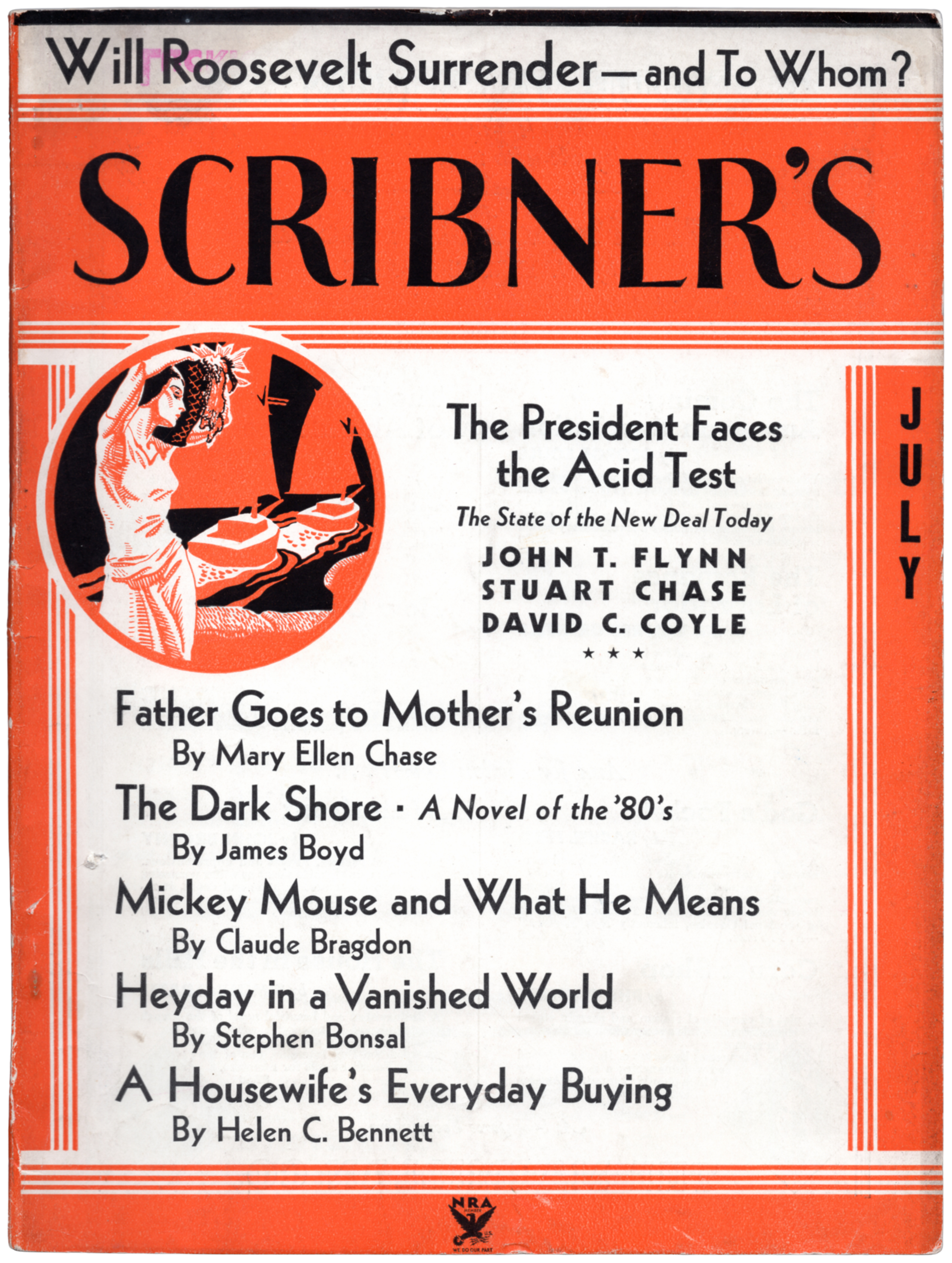
Bragdon’s 1934 article for Scribner’s Magazine, “Mickey Mouse and What He Means”, explores just that. Let’s dive in!
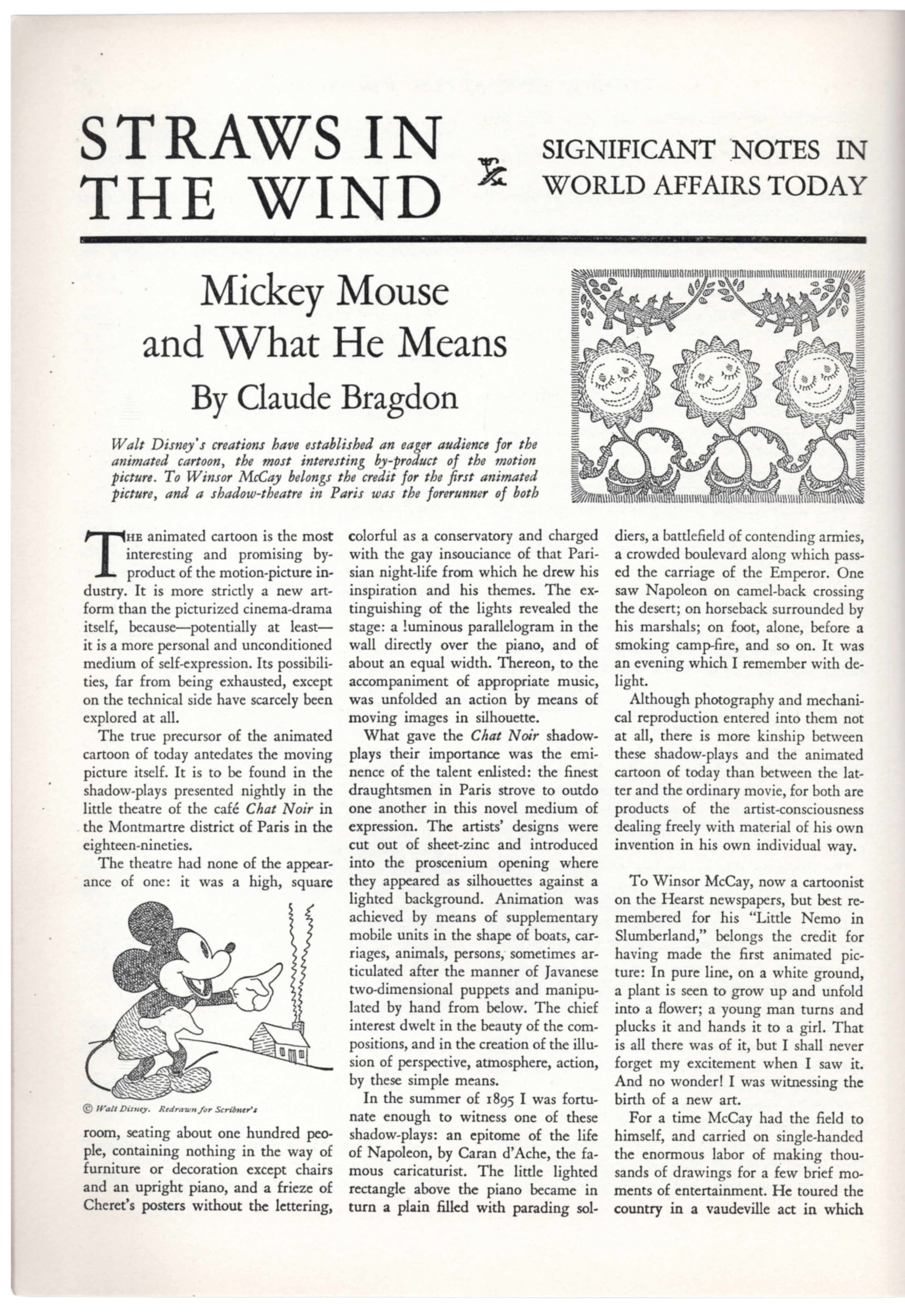
“The animated cartoon is the most interesting and promising byproduct of the motion-picture industry. It is more strictly a new art form than the picturized cinema-drama itself, because — potentially at least — it is a more personal and unconditioned medium of self-expression. Its possibilities, far from being exhausted, except on the technical side have scarcely been explored at all.
The true precursor of the animated cartoon of today antedates the moving picture itself. It is to be found in the shadow-plays presented nightly in the little theater of the café Chat Noir in the Montmartre district of Paris in the eighteen-nineties.
The theater had none of the appearance of one: it was a high, square room, seating about one hundred people, containing nothing in the way of furniture or decoration except chairs and an upright piano, and a frieze of Cheret’s posters without the lettering, colorful as a conservatory and charged with a gay insouciance of the Parisian night-life from which he drew his inspiration and his themes. The extinguishing of the lights revealed the stage: a luminous parallelogram in the wall directly over the piano, and of about an equal width. Thereon, to the accompaniment of appropriate music, was unfolded an action by means of moving images in silhouette.
What gave the Chat Noir shadow-plays their importance was the eminence of the talent enlisted: the finest draftsmen in Paris drove to outdo one another in this novel medium of expression. The artists’ designs were cut out of sheet-zinc and introduced into the proscenium opening where they appeared as silhouettes against a lighted background. Animation was achieved by means of supplementary mobile units in the shape of boats, carriages, animals, persons, sometimes articulated after the manner of Javanese two-dimensional puppets and manipulated by hand from below. The chief interest dwelt in the beauty of the compositions, and in the creation of the illusion of perspective, atmosphere, action, by the simple means.”
“In the summer of 1895 I was fortunate enough to witness one of the shadow-plays: an epitome of the life of Napoleon, by Caran d’Ache, the famous caricaturist. The little lighted rectangle above the piano became in turn a plain filled with parading soldiers, a battlefield of contending armies, a crowded boulevard along which passed the carriage of the Emperor. One saw Napoleon on camel-back crossing the desert; on horseback surrounded by his marshals; on foot, alone, before a smoking camp-fire, and so on. It was an evening which I remember with delight.
Although photography and mechanical reproduction entered into them not at all, there is more kinship between these shadow-plays and the animated cartoon of today than between the later and the ordinary movie, for both are products of the artist-consciousness dealing freely with material of his own invention in his own individual way.
To Winsor McCay, now a cartoonist on the Hearst newspapers, but best remembered for his ‘Little Nemo in Slumberland,’ belongs the credit for having made the first animated picture: In pure line, on a white ground, a plant is seen to grow up and unfold into a flower; a young man turns and plucks it and hands it to a girl.1 That is all there was of it, but I shall never forget my excitement when I saw it. And no wonder! I was witnessing the birth of a new art.
For a time McCay had the field to himself, and carried on single-handed the enormous labor of making thousands of drawings for a few brief moments of entertainment. He toured the country in a vaudeville act in which he used to exhibit a five-minute reel purporting to represent certain episodes in the life of Gertie, the trained dinosaur. McCay appeared on the stage arrayed in the costume of a circus animal-trainer and brandishing a whip. Presently, at his summons, on the screen behind him, Gertie is seen to emerge timidly from her cave. At his command she clumsily raises her right foot, and then her left, and is rewarded with a large red apple, tossed to her from her master’s hand. Under encouragement and with much whip-cracking she goes through her more difficult paces, and ends by throwing an elephant over a palm-tree by the tail and drinking the lake dry. The startled-faun psychology of Gertie and her fear of her trainer imparted a vein of more subtle humor to the obvious fun of the thing itself.”
“McCay chose a dinosaur for exploitation in order to prove to his critics and detractors that he worked independently of models and photographs. He used to get down on his hands and knees and go through certain bodily maneuvers, watching and timing every movement so that Gertie should have all the naturalness of life. In conception, draughtsmanship, and execution Gertie was a worthy precursor to Mickey Mouse.
It seems a pity that McCay, with his skilled technique and delightful fancy, should not have continued in this field which he had made his own. Walt Disney has so far eclipsed him that McCay’s animated cartoons are remembered only by old-timers like myself. I have told how he hit upon the dinosaur for his protagonist; this is how Disney came to choose the mouse.
In 1920, when he was employed in a commercial art studio in the Middle West, he used sometimes to work late at night. Toward midnight he often heard scratching against the metal wires of the waste-baskets which held the discarded lunchboxes of the staff. The mice were after their evening meal. From being merely interested, Disney became fascinated with the little creatures. He tamed the number of them and soon had them living together in a cage. One became so friendly that he allowed it on his desk while he worked. So though the actual idea of the Mickey Mouse saga came to him only afterward, while he was traveling on a train between New York and Hollywood, its germ had already been planted in his mind.
Soon after the war, Walt Disney and his brother Roy began making animated cartoons for which Walt provided both the scenarios and the drawings — fifteen hundred for each film. This proved profitable. Bent on expansion, he and a group of his friends produced the first Mickey Mouse cartoons. But the sound-film had arrived meantime, and to make these marketable it was necessary to introduce music and sound-effects. After discouragements and delays an independent company in New York was persuaded to make the sound synchronization, and thereafter the world took Mickey Mouse to its heart. Today Disney controls a big film studio in Hollywood.
This, briefly, is the way these animated cartoons are made: First a ‘gag’ meeting is held in which the idea is determined upon and discussed. Scenario writers next compose a regular transcript, which adapters subdivide into sequences, scenes, and shots. The scenic department then designs the backgrounds, following which three kinds of artists set to work. The first are ‘animators,’ who developed the gags, but draw only the beginning and end of an action; the second are ‘in-betweeners,’ who supply the delicately graded changes which make motion kinetic; the third are the ‘inkers,’ who boldly trace these drawings in ink on transparent celluloid. To photograph these thousands of drawings the camera is placed on a fixed mount, pointing down on the board on which the drawings are confined by a hinged and glazed metal frame. A motor-drive, working through a clutch, exposes one ‘frame’ each time a button is pressed.”
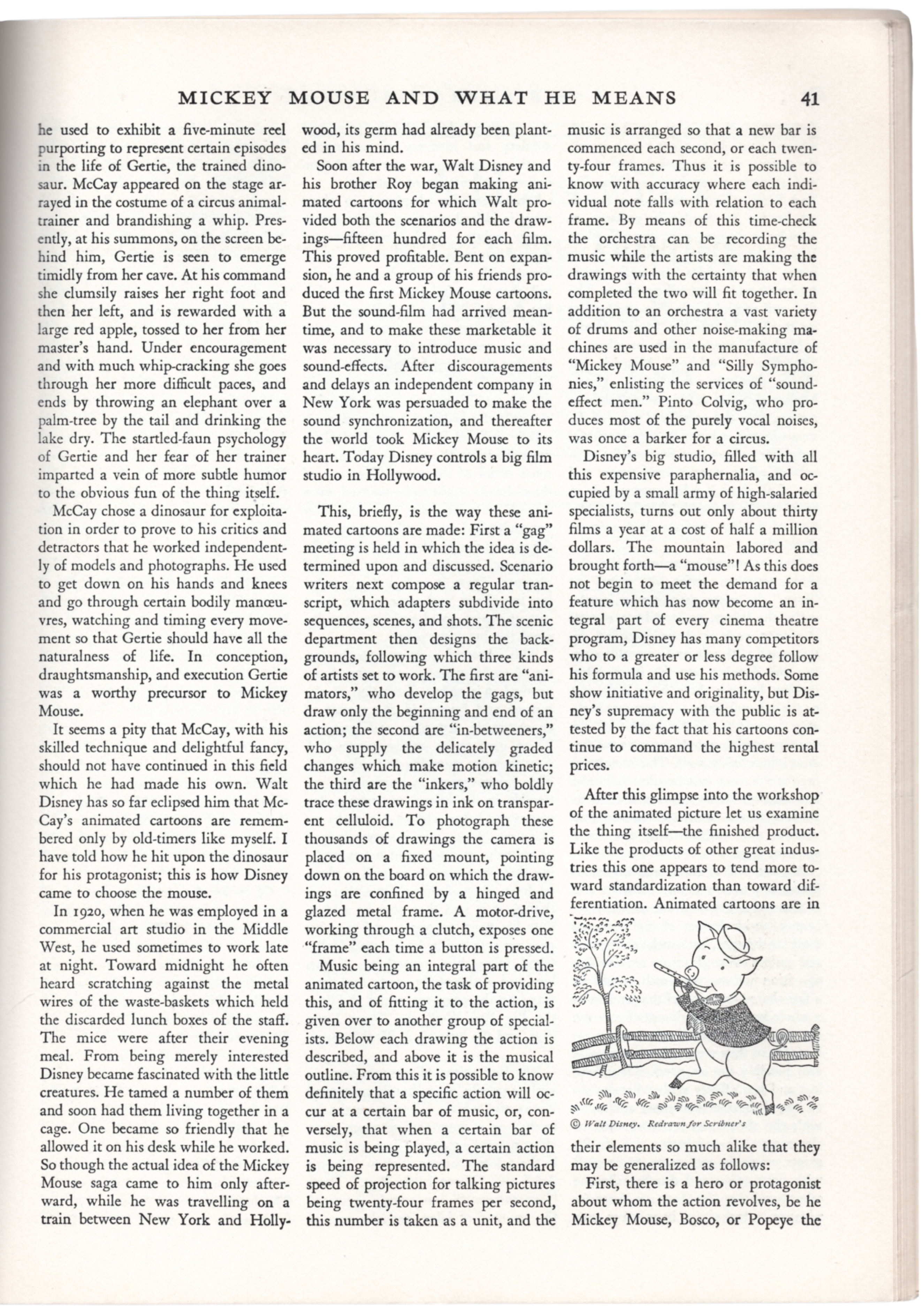
“Music being an integral part of the animated cartoon, the task of providing this, and of fitting it to the action, is given over to another group of specialists. Below each drawing the action is described, and above it is the musical outline. From this it is possible to know definitely that a specific action will occur at a certain bar of music, or, conversely, that when a certain bar of music is being played, a certain action is being represented. The standard speed of projection for talking pictures being twenty-four frames per second, this number is taken as a unit, and the music is arranged so that a new bar is commenced each second, or each twenty-four frames. Thus it is possible to know with accuracy where each individual note falls with relation to each frame. By means of this time-check the orchestra can be recording the music while the artists are making the drawings with the certainty that when completed the two will fit together. In addition to an orchestra a vast variety of drums and other noise-making machines are used in the manufacture of ‘Mickey Mouse’ and ‘Silly Symphonies,’ enlisting the services of ‘sound-effect men.’2 Pinto Colvig, who produces most of the purely vocal noises, was once a barker for a circus.
Disney’s big studio, filled with all this expensive paraphernalia, and occupied by a small army of high-salaried specialists, turns out only about thirty films a year at the cost of half a million dollars. The mountain labored and brought forth — a ‘mouse’! As this does not begin to meet the demand for a feature which has now become an integral part of every cinema theater program, Disney has many competitors who to a greater or less degree follow his formula and use his methods. Some show initiative and originality, but Disney’s supremacy with the public is attested by the fact that his cartoons continued to command the highest rental prices.
After this glimpse into the workshop of the animated picture let us examine the thing itself — the finished product. Like the products of other great industries this one appears to tend more toward standardization than toward differentiation. Animated cartoons are in their elements so much alike that they may be generalized as follows:
First, there is a hero or protagonist about whom the action revolves, be he Mickey Mouse, Bosco, or Popeye the Sailor. Second, there is a villain with whom, as in old-fashioned melodrama, the hero is ever in conflict, and in the end thwarts or overcomes (The Big Bad Wolf). Third, there is a character known in vaudeville parlance as a feeder or stooge — some one who plays into the hands of the hero, adds to his lustre, and provides him with opportunities for his most telling effects. The first and second Little Pigs are feeders for the Third Little Pig. Minnie Mouse is Mickey Mouse‘s feeder — as when, in ‘Building a Building’ Minnie‘s hat blows into the excavation, giving Mickey a chance deftly and gallantly to retrieve it in the great iron maw of the steam-shovel which he is operating. Subsidiary characters are usually variants of other standardized types, and last of all there is what corresponds in opera to the ensemble, for the production of highly intricate and animate mass-effects.
Most animated cartoons consist of a strung-together series of stunts or ‘gags’ the more preposterous, apparently, the better, enacted by a cast of characters such as above described, interspersed with solo and ensemble singing and dancing, not felt as an interruption because there is so little plot or logical continuity to interrupt. Probably four-fifths of the output of the various studios would answer to this description fairly well. The remainder are for the most part familiar folk-tales, and Mother Goose stories re-told according to the animated cartoon convention and enlivened by the usual sure-fire gags.
A great deal of clever and ingenious invention; some measure of fancy and fantasy; a little — almost accidental — beauty amid deserts of ugliness; no food for thought, but much for the ventral variety of laughter; no creative imagination whatsoever — such would be a fair characterization of the product as a whole from the standpoint of concept. On this side animated cartoons are no better than they were a few years back, and possibly not as good. They have less and less affinity with what is called ‘good theater’ and more and more with the three-ringed circus, with its clowning and acrobatics, its thrills, stunts, surprises and races punctuated with destruction and disaster. On the other hand there has been an immense advance in technique, in mastery over the medium, shown in the improved subtlety and intricacy of movement, spatial orchestration, sound-synchronization, and matters of that sort.
The virtuosity displayed in these ways is indeed amazing. There are so many subtle, rapid, perfectly-timed movements going on all at once, combined with such multiplication of detail, that the mind and eye cannot follow them all. ‘Three Little Pigs’ is one of the simplest pictures, yet how many persons, seeing it for the first time, notice that the Third Little Pigs’ house is laid up in ‘wolf proof cement,’ take in all the family portraits, or notice that not only the bedstead but the piano is solidly built of brick? If they do it is most likely at the expense of missing some detail of the action. Not one of these details ought to be omitted, even though we miss them, but when they are multiplied out of all measure, as is the case in many other films, bewilderment and boredom take the place of pleasure. There is such a thing as being too clever, and some of the latest cartoons carry speed and ingenuity beyond the breaking point.
This increased mastery over the factor of mobility has on the other hand, resulted in a richer distillation of eloquence and humor in the matter of characteristic attitudes and gestures. These used to be jerkily generalized, now that they are smoothly individualized. This improvement is particularly noticeable in the animal pictures: a dog moves and behaves like a dog, and a cat like a cat. Disney, who is avowedly fond of animals, used to spend hours studying their true motion, as well as slowed-down films of animals in action. Although it is said that now he seldom puts his hand to paper, and that his gags are supplied by highly paid Hollywood jokesmiths, something of this love and of this study surely find their way into the engaging antics of Pluto, the Big Bad Wolf, the Three Little Pigs, and the animals of Noah’s cargo.”
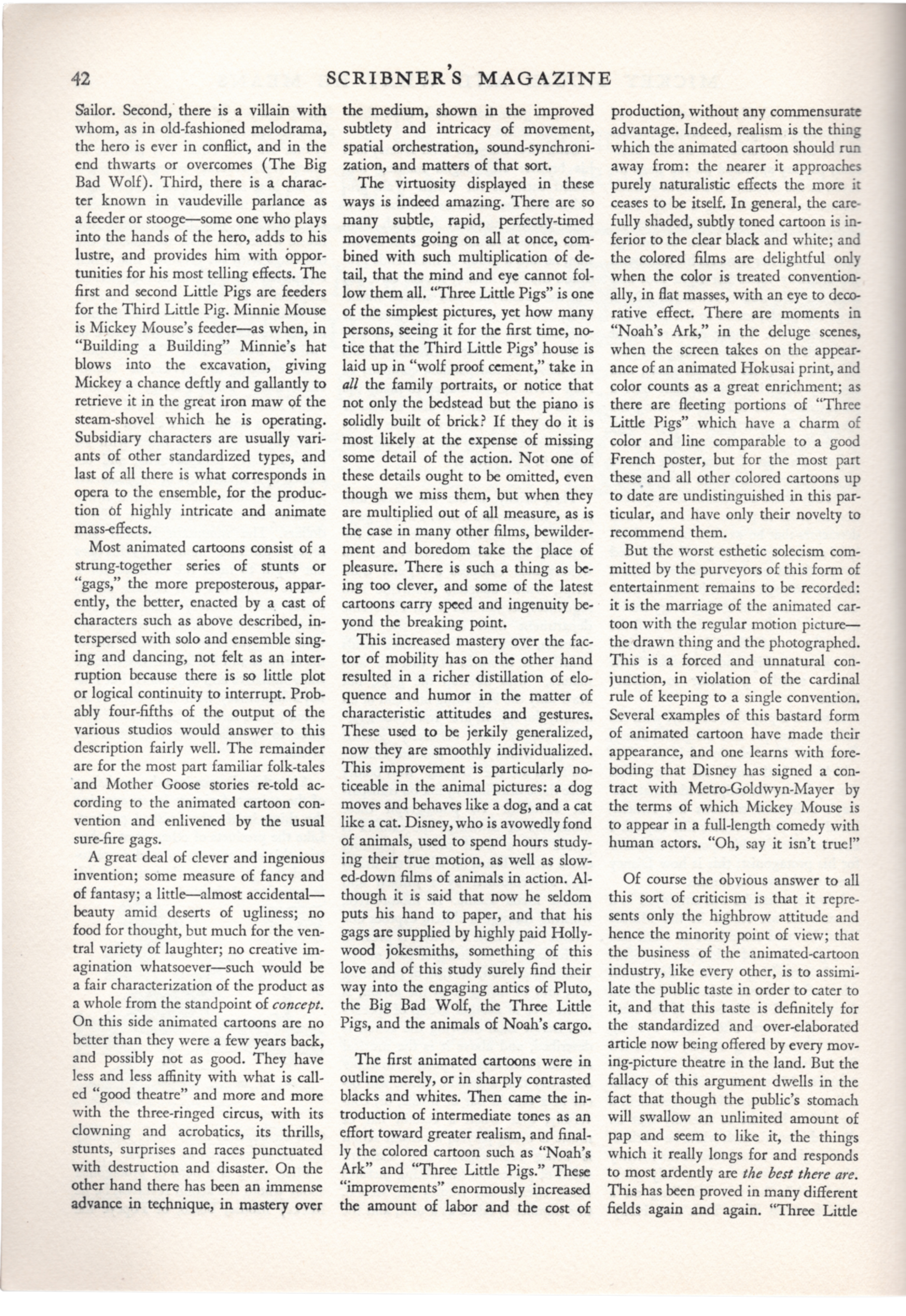
“The first animated cartoons were in outline merely, or in sharply contrasted blacks and whites. Then came the introduction of intermediate tones as an effort toward greater realism, and finally the colored cartoon such as ‘Noah’s Arc’ and ‘Three Little Pigs.’ These ‘improvements’ enormously increased the amount of labor and the cost of production, without any commensurate advantage. Indeed, realism is the thing which the animated cartoon should run away from: the nearer it approaches purely naturalistic effects the more it ceases to be itself. In general, the carefully shaded, subtly toned cartoon is inferior to the clear black and white; and the colored films are delightful only when the color is treated conventionally, in flat masses, with an eye to decorative effect. There are moments in ‘Noah’s Ark,’ in the deluge scenes, when the screen takes on the appearance of the animated Hokusai print, and color counts as a great enrichment; as there are fleeting portions of ‘Three Little Pigs’ which have a charm of color and line comparable to a good French poster, but for the most part these and all other colored cartoons, up to date are undistinguished in this particular, and have only their novelty to recommend them.
But the worst esthetic solecism committed by the purveyors of this form of entertainment remains to be recorded: it is the marriage of the animated cartoon with the regular motion picture — the drawn thing and the photographed. This is a forced and unnatural conjunction, in violation of the cardinal rule of keeping to a single convention.3 Several examples of this bastard form of animated cartoon have made their appearance, and one learns with foreboding that Disney has signed a contract with Metro-Goldwyn-Mayer by the terms of which Mickey Mouse is to appear in a full-length comedy with human actors. ‘Oh, say it isn’t true!’
Of course, the obvious answer to all this sort of criticism is that it represents only the highbrow attitude and hence the minority point of view; that the business of the animated-cartoon industry, like every other, is to assimilate the public taste in order to cater to it, and that this taste is definitely for the standardized and over-elaborated article now being offered by every moving-picture theatre in the land. But the fallacy of this argument dwells in the fact that though the public’s stomach will swallow an unlimited amount of pap and seem to like it, the things which it really longs for and responds to most ardently are the best there are. This has been proved in many different fields again and again. ‘Three Little Pigs,’ which is the best animated cartoon to date judged by any standard, is also the most popular, though it has little kinship with the standardized article.”
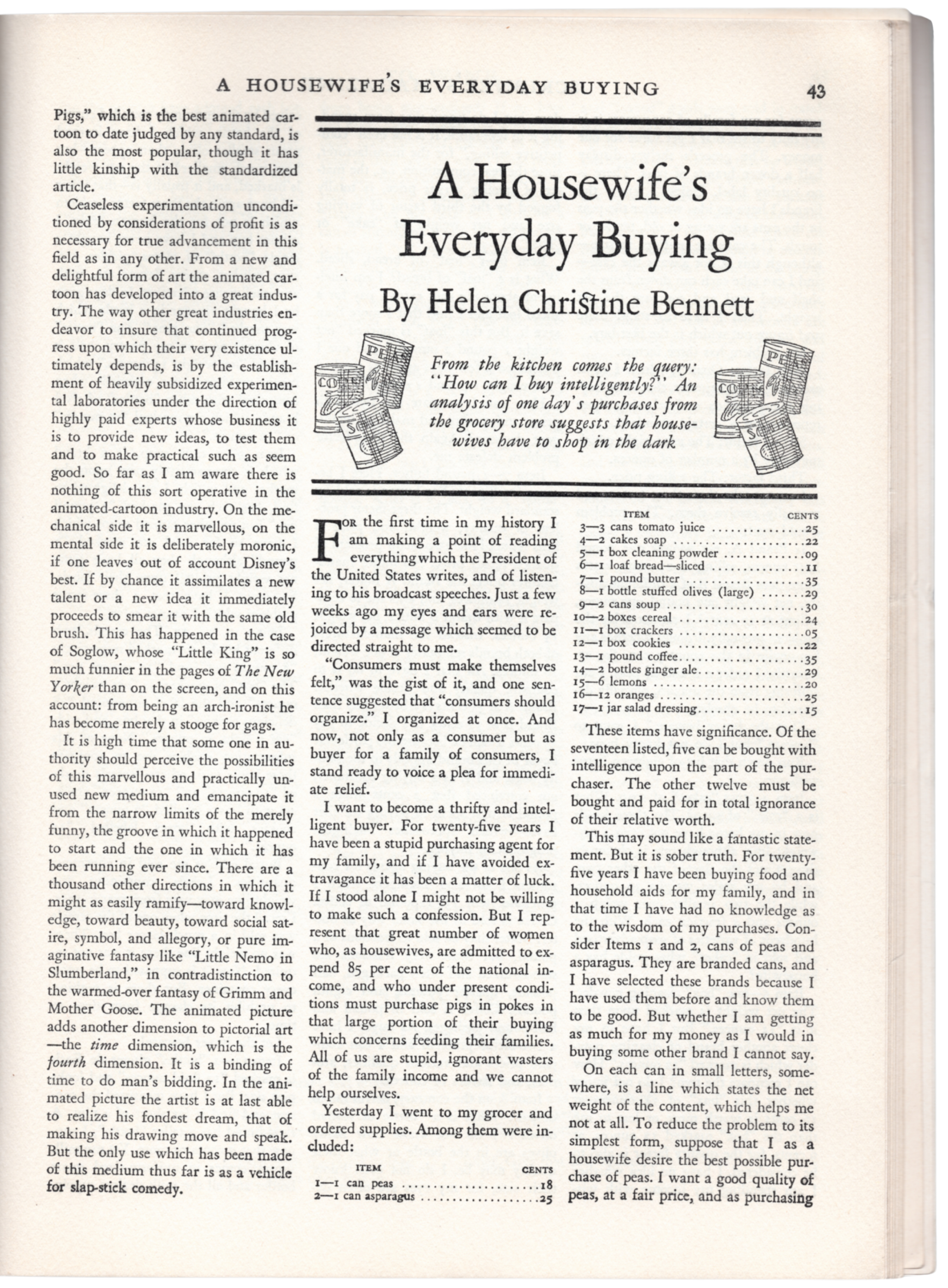
“Ceaseless experimentation unconditioned by considerations of profit is as necessary for true advancement in this field as in any other. From a new and delightful form of art the animated cartoon has developed into a great industry. The way other great industries endeavor to insure that continued progress upon which their very existence ultimately depends, is by the establishment of heavily subsidized experimental laboratories under the direction of highly paid experts whose business it is to provide new ideas, to test them and make practical such as seem good. So far as I am aware there is nothing of this sort operative in the animated-cartoon industry. On the mechanical side it is marvellous, on the mental side it is deliberately moronic, if one leaves out of account Disney’s best. If by chance it assimilates a new talent or a new idea it immediately proceeds to smear it with the same old brush. This has happened in the case of Soglow, whose ‘Little King’ is so much funnier in the pages of The New Yorker than on the screen, and on this account: from being an arch-ironist he has become merely a stooge for gags.
It is high time that someone in authority should perceive the possibilities of this marvellous and practically unused new media and emancipate it from the narrow limits of the merely funny, the groove in which it happened to start and the one in which it has been running ever since. There are a thousand other directions in which it might as easily ramify — toward knowledge, toward beauty, towards social satire, symbol, and allegory, or pure imaginative fantasy like ‘Little Nemo in Slumberland,’ in contradistinction to the warmed-over fantasy of Grimm and Mother Goose. The animated picture adds another dimension to pictorial art — the time dimension, which is the fourth dimension. It is a binding of time to do man’s bidding. In the animated picture the artist is at last able to realize his fondest dream, that of making his drawing move and speak. But the only use which has been made of this medium thus far is a vehicle for slap-stick comedy.”

Well, there we have it! I hadn’t come across many critiques of early animation prior to this piece, and I found Bragdon’s declarations to be incredibly thought-provoking for the historical period in which he made them. We know that the best was still to come in terms of animation quality and storytelling, but I’d be curious to know how Bragdon viewed the first animated films produced by Walt Disney Studios prior to his passing in September 1946. These may just be the things that keep me up at night…
If you enjoyed today’s post, be sure to smash that lil’ heart icon below! It helps increase this post’s visibility on Substack and brings more folks closer to the magic. As always, thank you so much for reading. I appreciate you being here.
See ya real soon,

👋🏻 Lookin’ for more magic? Come say “hi” on Instagram!
☕ Help fuel those early mornings and late nights by buying me a coffee
💬 Found something in this post that resonated with you? Highlight and share it as a note to your Substack feed!
💌 Spread the magic by sending this post to a fellow Disney nerd
🗣️ Got a Substack of your own? Recommend Magic, Noted to your readers!
While McCay claimed to be the first to animate a motion picture, he was preceded by other animators such as Frenchman Émile Cohl and American James Stuart Blackton.
Hired by the Walt Disney Studios in 1934 as a percussionist, James "Jimmy" MacDonald led the sound effects department where he created over 28,000 organic sounds by way of everyday objects to custom-built machines. The work of his predecessor, Ben Sharpsteen, laid the groundwork for the studio’s foley and sound-mixing methods.
R.I.P. Claude Bragdon, you would’ve loved Mary Poppins. He and P.L. Travers would certainly get along on that point!