

Marginalia, vol. 2
The one where I finally give time-blocking a shot

You’re reading Marginalia — a regular series that documents the not-so-linear process, inner workings, and highs and lows of an independent Disney research project. If you’d like to read more of these posts, feel free to check out the archives.
Happy Wednesday, readers! The sun is high in the sky, our neighborhood pool is the place to be, and the freezer is stocked with my favorite popsicles — summer has arrived. As the daughter of two retired history teachers, this time of year always elicits a deep desire to slow down and savor what makes me feel “buzzy” inside. Our summers were full of trips to the local library and Houston’s outstanding museums, reading big ole books and diving into topics that I wouldn’t otherwise have had time to explore, and spending weeks at a time on the Alabama coast or road-tripping to far-off places overflowing with rich historical significance (like my Dad, I’m partial to the American South). Summers were — and, I suppose, still are — for studying.
This year though, that effervescent feeling has manifested in the form of an independent Disney research project that I’m labeling as “Project Robin”. I briefly explored its origins in my previous post so if you missed that one, feel free to check it out:

Since then, I’ve switched some things up, poured many hours into locating and consolidating existing information (and I’ve still got loads to sift through), and narrowed my focus on just what I’m setting out to do — in more ways than one.
We’ve got quite a few updates to unpack, so let’s dive in!

Tools and resources
I’m a huge stationery nut and when something — a planner, journal system, fountain pen, etc. — isn’t quite working for me, I pick up on it pretty quickly. I previously mentioned that I decided to use a Leuchtturm journal (one of my tried-and-true favorites!) as a research notebook but I found it to be a bit cumbersome and limiting in just how I wanted to use it.
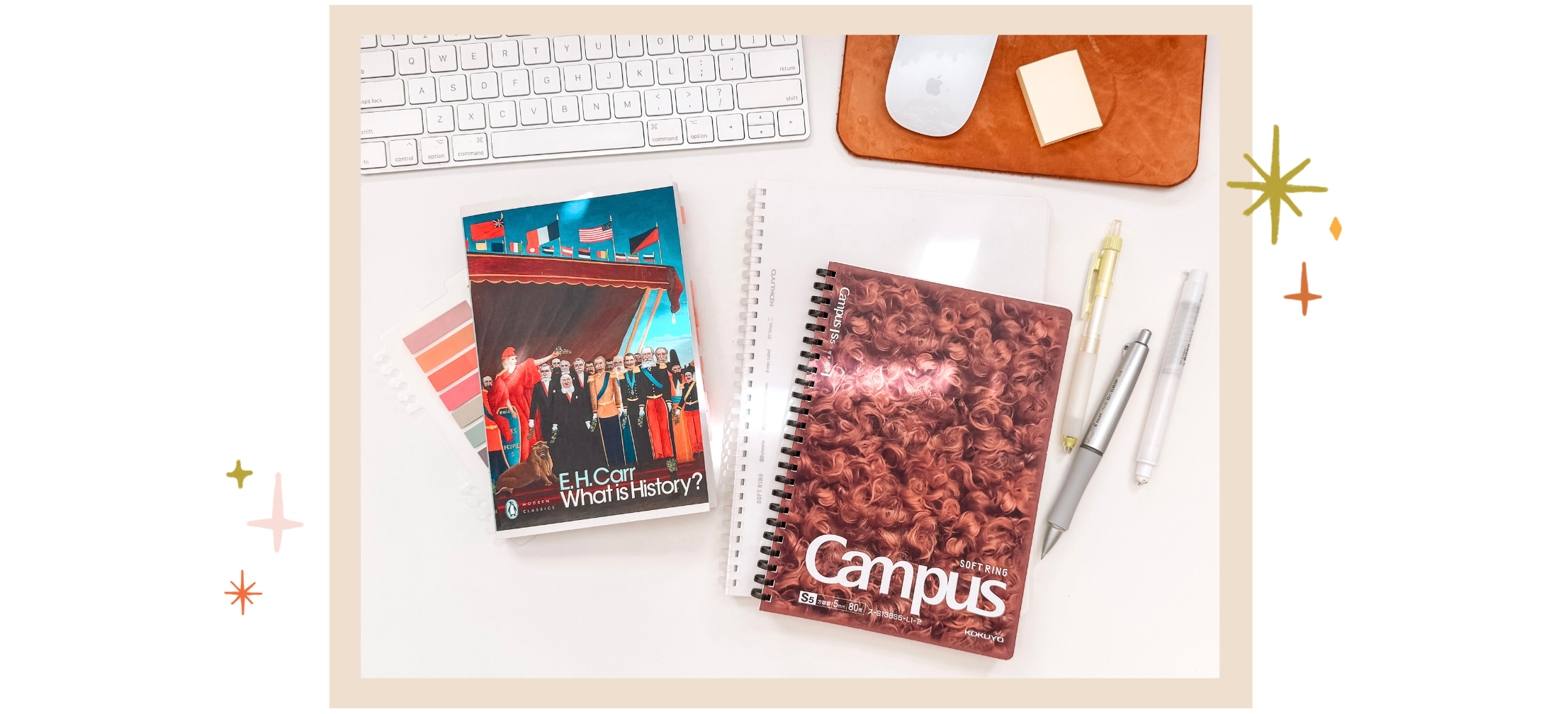
So, I swapped it out for a couple different options — a B5 lined notebook and an A5 graph notebook. Both notebooks are spiral-bound, but the best part is that the spiral is a super flexible, plastic material that makes for the most comfortable writing experience. I love them!
I grabbed two different spirals to serve two different purposes. The larger one is a dedicated notebook for my raw thoughts, questions, and connections as they pertain to my research and the smaller spiral is a space for personal reflections on the research process itself. This change has been a substantial improvement for my productivity and mental clarity. When things aren’t going right, go left (to JetPens).
Data and organization
At the very beginning of this project, I wasn’t really sure of how best to structure my data ecosystem or where to safely store it. I didn’t want to commit to something that I wouldn’t end up finding useful, so I poked around the internet and pulled some options together (big shoutout to all the past and present PhD candidates of the world who share their two-cents with others).
Firstly, I decided to use Goodnotes for housing my notes, outlines, mind maps, and general findings. It’s simple and inexpensive, and I like how it seamlessly functions across different devices (i.e. computer, tablet, etc.). I use Apple products, so my documents are backed up to iCloud every several seconds. I can also back-up my files manually to my SSD or computer.
I also got settled with Zotero, which is a free application that stores and organizes reference material. It’s integrated into Google Chrome for easy cataloguing, and it’s also able to sync with Notion databases through a plug-in called Notero. It’s a nifty piece of software that has made the resource juggling act just a bit easier to manage.
Hurdles and challenges
Getting out of my own way
Honestly, the biggest challenge I’ve faced thus far is the crippling overwhelm of imposter syndrome. We all know and love it. “Who am I to think that I can take on independent historical research? I’m not a historian. I’m probably not even doing this right. I should just leave it alone for the actual Disney historians to pick up!” Crazy, huh? I’m truly my own worst enemy but with the right mental reframing, I can pull myself out of this headspace fairly quickly.
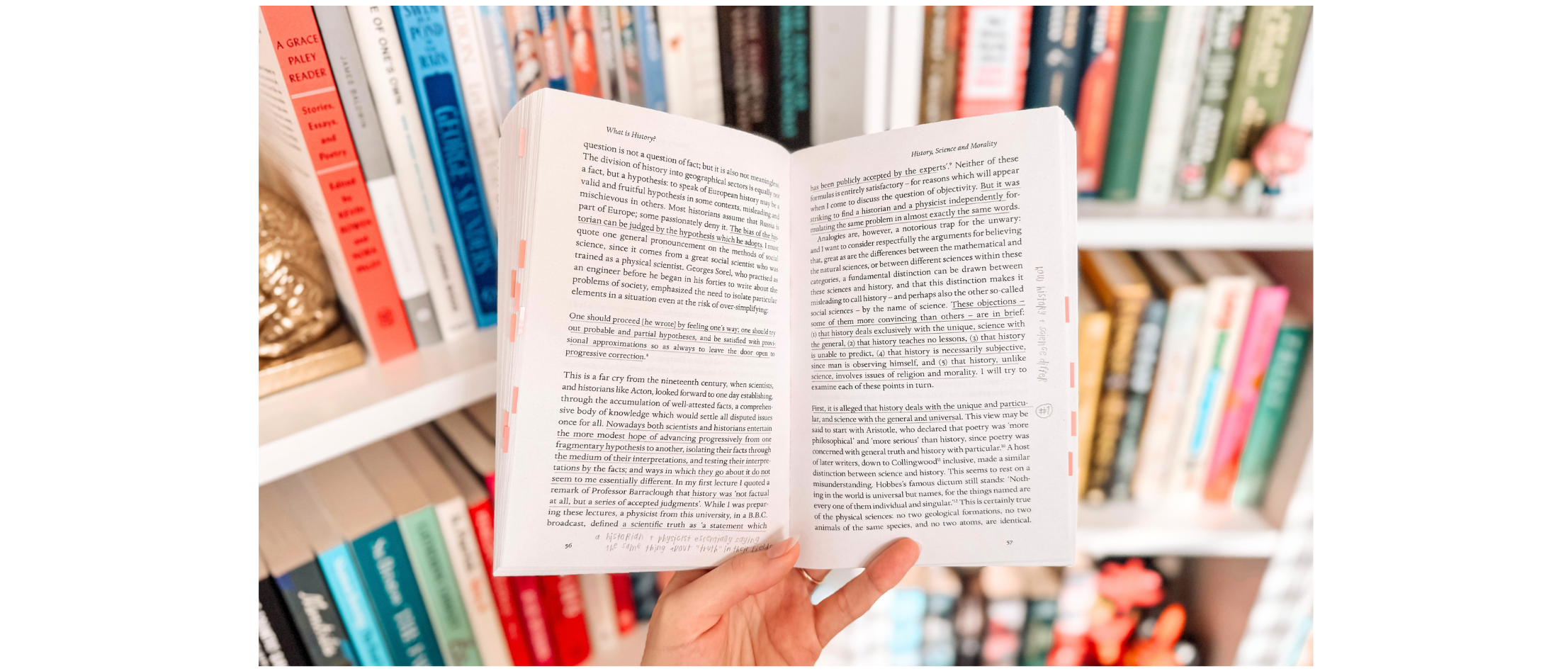
In fact, one approach I’ve adopted is responding to these moments as learning opportunities. Okay, so I’m not an academically-trained historian. In what ways can I “catch up” to them, and in what ways can I utilize my existing research skills as a geospatial scientist?
For starters, I’ve been reading E.H. Carr’s What Is History? Published in 1961 as a series of lectures at the University of Cambridge to an audience largely comprised of intellectuals, a portion of this book has been soaring (and I mean soaring) over my head. However, the primary arguments are clear and engaging, and I’m learning quite a bit from it thus far. I’ll be sure to share more organized thoughts once I’ve wrapped up my reading.
Fun fact: Carr was also not a “traditional” historian, but his aforementioned work is often cited as a principal text for breaking down and understanding the nuances and complexities of historiography, or the history of history. He’s most known, however, for authoring a 14-volume series on Soviet Russia.1 Certainly no small feat, classically-trained historian or not.
Me and time-blocking against the world
Oh, but it doesn’t stop there! Time management has been another challenge that I’ve had to face head-on over the last couple months. After factoring in my full-time gig, appointments, meal times, household chores, and all those fun “adulting” things, I have a hard time understanding just how much time I have left in the day to do the things that I actually want to do. I’m flexible in many areas of my life but when plans change or time becomes even more limited, I tend to freeze and do not much at all. It’s…a problem.
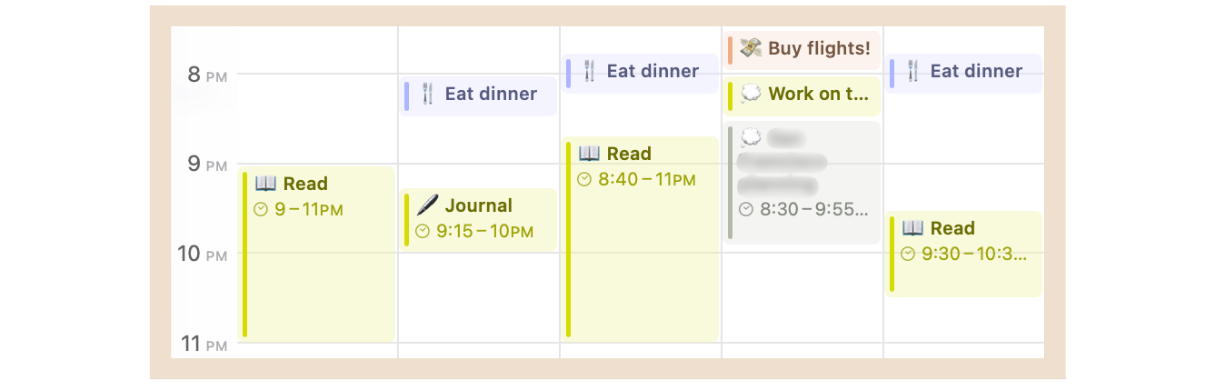
The good news, though? Most problems have solutions. I’m a very visual learner so when I thought about how best to address this, I knew I’d need to see those precious 24 hours laid out in front of me. Digital planning has never been my style, but it works remarkably well for this. Who knew? (Yes, yes. I know.) Every morning, I sit down and roughly time-block my day on my Apple calendar. I add my non-negotiable tasks and activities (i.e. meal times, meetings and appointments, workouts, morning and evening routines, etc.) and consider what I have left. Any extra time can be used for the things I want to prioritize that day — reading, Substack tasks, research, or anything else that might need to be touched on or completed.
I’ve followed this approach for a few weeks, and not only has it allowed me to better visualize the hours in my day but it’s also held me accountable to ensure I’m using my time effectively. I still goof around and get distracted by the occasional, random side quest, but it’s been a massive improvement for my day-to-day productivity. I also love the streamlined design and functionality of the calendar interface; less distractions tend to produce improved focus, at least for my brain. Problem, meet solution.
Moments of magic
Getting into a groove. You know that feeling of scissors effortlessly gliding across wrapping paper? Yea, that’s what a good groove feels like when neck-deep in research. In moments like this, the process fuels itself. Having one source lead you to another nugget of information only for you to uncover something entirely new; it can be so fun and so addicting.
Collaborating with a librarian to connect the dots. After reaching out to a public library with some questions pertaining to my research, I began a working relationship with a librarian who’s ecstatic that my topic revolves around Disney history. She’s helped me expand upon some findings, and we’ve even filled in some gaps that were originally illuminated by the existing source material. It’s true what they say — it takes a village! I’m grateful to have research companion in my corner.
Lessons learned
I’m a fairly impatient person. I prefer for things to be done quickly and efficiently, and I like seeing feedback or results throughout the process of any given task. Historical research, I’ve found, is quite possibly the antithesis of that. Locating source material, tracking down and contacting potential connections (only to receive *crickets*), and following intriguing leads down mile-long rabbit holes are slow, time-consuming work that can often be unfruitful. It’s a process that not only requires patience, but can also reward those who equip themselves with an endurance for the task at hand.
I’ve become a lot more familiar with patience — it’s applications, temperament, and benefits — over the last couple months. More than anything else, an inability to study or research has proved to be the most frustrating aspect of this work and, consequently, require the most patience.
There are days when other things take priority or I feel unexcited about staring at my computer screen for an additional three hours, and that’s okay. However, the mental fallout of these decisions can add up over time if they prove to be a consistent reoccurrence. “I need to make progress because I’m falling behind. How can I be a ‘scholar’ or ‘historian’ if I don’t sit down and commit to my research everyday? It doesn’t work unless you do.” These are all thoughts that I’ve had recently. Some are true and helpful, but they’re not always conducive to managing a calm, balanced headspace.
I’ve done a lot of things since the first installment of this series, but serving reminders to extend patience to myself has been at the top of the list. The absolute tippy top. And to be honest? I’m all the better for it.
What’s next?
Prioritizing a dedicated library trip in the next couple weeks! I’m thinking this will occur on or around the upcoming holiday weekend, so I should be able to camp out for a while and comb through a handful of relevant primary and secondary sources. It’ll be the first of many visits, I’m sure.
Visiting a special lil’ place next month. While my research topic is not the primary focus of this spot, it’s still heavily related to it. Much of what I’ll be looking at will tie directly into my research, so I’m very excited to view it through that lens. Stay tuned for more on this!
Sharing more about the research process on and off of Substack. Without over-generalizing, I think most people aren’t too familiar with what it is to actually research a topic of interest. After all, the act is traditionally reserved for academics or people with substantial resources through whatever means. However, public scholarship is a very real thing that’s accessible for so many folks. I want to share what that looks like as someone who’s just fascinated by Disney history and wants to make their own contribution to the existing body of knowledge. We’re building this house brick by brick, baby! Again, stay tuned for more and be sure to follow along on Instagram and YouTube.
Posts you might have missed


Whew — that was long one. As it turns out, I’ve got quite a bit to say about this process. I’m studying history and, as a consequence, myself.
If you enjoyed today’s post, be sure to smash that lil’ heart icon below! It helps increase this post’s visibility on Substack and brings more folks closer to the magic. As always, thank you so much for reading. I appreciate you being here.
See ya real soon,

👋🏻 Lookin’ for more magic? Come say “hi” on Instagram!
☕ Help fuel those early mornings and late nights by buying me a coffee
💬 Found something in this post that resonated with you? Highlight and share it as a note to your Substack feed!
💌 Spread the magic by sending this post to a fellow Disney nerd
🗣️ Got a Substack of your own? Recommend Magic, Noted to your readers!
Random, unrelated fact: my Dad studied the Soviet Union in graduate school so out of curiosity, I asked him if he had previously read anything by Carr. He thought he did but wasn’t entirely sure, but decided to pick up the first volume of the series last week! That’s likely the closest I’ll ever get to doing a “buddy read” with my Dad.